
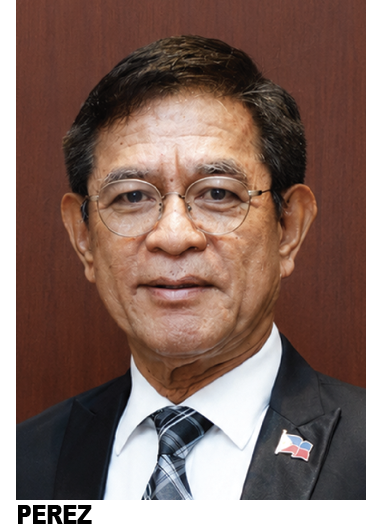
By Secretary Ernesto V. Perez
ARTA Secretary and Director General
(8th State of the ARTA Address, May 22, 2026)
Distinguished members of the Cabinet, honorable officials of the national government, our partners in local government, representatives from the diplomatic corps, representatives from the private sector, our development partners, fellow public servants, the men and women of the Anti-Red Tape Authority, ladies and gentlemen, magandang hapon po sa inyong lahat.
Today, we gather to celebrate the 8th Anniversary of the Anti-Red Tape Authority.
This year’s theme is both a celebration and a challenge: Elevate Trust: Transparency and Accountability for a Bagong Pilipinas. This theme speaks directly to the national direction set by President Ferdinand R. Marcos Jr., who gave a candid reminder of the challenge before us when he said: “On the ease of doing business, again, it’s the bureaucracy that gets in the way. Just make it easier for people to come, and should they decide to invest in the Philippines, then make it easy for them.” That message is simple, but it cuts to the heart of our mandate.
And as we gather today, we do more than mark another year. We do more than report numbers, list accomplishments, or recount milestones.
We pause to ask the questions that every public institution must ask of itself if it wishes to remain worthy of the people’s trust:
Did our work make a difference?
Did it reach the citizen waiting in line?
Did it make government clearer, faster, fairer, and more accountable?
At eight years, ARTA’s work has moved beyond isolated interventions and one-time compliance efforts.
What began with speed, grew through unity, and found connection through bridges now resonates across government, creating waves of change that help the nation navigate the future through better service, stronger business confidence, and a public sector that works with greater clarity, accountability, and purpose.
We spoke of speed because a country with urgent needs cannot be served by a bureaucracy that moves too slowly.
We spoke of unity because the work of reform cannot be carried out by one agency alone. It requires many hands, many institutions, and one common purpose.
We spoke of bridges because reform must connect — government to citizens, agencies to agencies, regulation to development, technology to service, and ambition to action.
Today, we speak of resonance. Because when speed, unity, and bridges come together, reform no longer remains an isolated act. It begins to move outward. It creates ripples. Those ripples become waves. And those waves begin to reshape the culture of service across government.
And so today, we ask: Where do ARTA’s reforms now resonate? They resonate in the lives of citizens. They resonate with the confidence of businesses and investors. They resonate in the behavior of government agencies. They resonate with digital transformation and transparency. And they resonate with the country’s readiness for the future.
For many Filipinos, red tape is not an abstract idea. It is not just a phrase in a law or a topic in a policy discussion. Red tape is experienced in wasted hours, repeated visits, unclear instructions, additional photocopies, unexpected requirements, and the feeling that the government is too difficult to navigate. So when ARTA works to simplify government, we are not only changing forms. We are changing the experience of people.
This is why the Report Card Survey 2.0 matters. It gives citizens a voice in measuring how the government actually serves. In its first full cycle, the RCS covered 1,764 offices nationwide, expanding from 860 offices in 2023 to 904 offices in 2024, while citizen respondents increased from 20,141 to 25,654.
These are not just survey figures. These are voices. These are experiences. These are Filipinos telling us where government works — and where government must still do better.
Through the Harmonized Client Satisfaction Measurement, we are also making feedback part of the discipline of service. CSM submissions increased from 642 reports in CY 2023 to 1,120 reports in CY 2024, covering 10,016 offices. This tells us something important: government is learning not only to deliver services, but to listen after the service has been delivered. And listening matters.
Ease of Doing Business fairs
The Grand EODB Fairs represent ARTA’s effort to make the ease of doing business felt directly by citizens, entrepreneurs, and communities.
Conducted as part of the annual Ease of Doing Business Month pursuant to Presidential Proclamation No. 818, the fairs simulate a one-stop shop by gathering national agencies, local government units, and service providers in a single venue to deliver frontline services, information, and assistance.
Our largest EODB Fair, held in Batangas, was able to process 5,290 transactions covering 2,196 services rendered to 3,094 in just 1 Day.
For citizens
For the citizen, reform becomes real when government stops being a guessing game. It becomes real when requirements are clear before they leave the house; when fees are known before they reach the counter; when timelines are honored not only on paper, but in practice; and when no citizen is left asking, “Saan po ako pupunta? Kanino po ako lalapit? Ano pa po ang kulang?”
And when citizens still encounter delay, confusion, or difficulty, ARTA is building more ways for them to be heard. Through eCMS, TALA kiosks, and digital widgets, complaint handling and legal workflows are being brought into a more accessible, AI-enabled, and citizen-centered ecosystem.
TALA AI is designed to provide 24/7 assistance, support 17 local languages, and help citizens file and track complaints and inquire about Citizen’s Charter information.
Through the AI-powered TALA and eCMS channels, ARTA also received 2,021 complaints from September 2025 to April 2026, with 1,556 closed and 465 ongoing.
These tools are not merely technological upgrades. They are instruments of access.
They help ensure that the citizen who cannot visit an office, the citizen who does not know where to begin, and the citizen who feels unheard, can still find a channel to government.
This is resonance in the life of the citizen: government becomes less of a maze and more of a map. The citizen is no longer left guessing. The voice of the public is no longer invisible. Public service becomes not only faster but also clearer, fairer, and more humane.
Because at its deepest level, ease of doing business is also ease of living.
A permit is not just paper. It is permission to begin. It is the difference between waiting and earning, between uncertainty and confidence, between an idea and a livelihood.
This is why ARTA’s mandate is not only administrative. It is economic. It is developmental. It is national. When government processes move faster, businesses can open sooner. When permits are streamlined, projects can proceed with greater confidence.
When regulations are clearer, investors can make decisions with greater certainty. When agencies coordinate, the economy moves with less friction.
We see this in the continuing push for the electronic Business One-Stop Shop, or eBOSS. In LGUs with comparable data, business registrations increased from 683,651 in CY 2022 to 777,398 in CY 2025, while total LGU business-permit-related revenue increased from P51.96 billion to P112.69 billion.
Behind those figures are businesses that registered, renewed, complied, and participated in the local economy. Behind those businesses are families, employees, suppliers, communities, and dreams made possible because the government chose to make entry into the formal economy easier.
The same principle applies to digital infrastructure. Through the implementation of Executive Order No. 32, the turnaround time for tower energization was reduced from 255 to 300 days to 59 days, while LGU-approved permits for telecommunications construction increased from 6,117 in May 2022 to 10,447 in December 2025. In partnership with ADB and PricewaterhouseCoopers, we have developed the NEHEMIA Report, which contains concrete steps to streamline the Digital Infrastructure and Renewable Energy Sectors.
In addition, we have signed and are currently implementing, with the DOE, DILG, and DPWH, the Joint Memorandum Circular on Energy Infrastructure Projects, which aims to standardize the documentary requirements and processing times for energy-related permits across local government units (LGUs).
Water red tape
Additionally, we have submitted the proposed Executive Order on Water for final comments and approval from the Office of the President. This streamlines the permitting process for the construction, repair, and maintenance of water supply and wastewater systems. It also addresses the restoration and rehabilitation of affected road pavements and sidewalks along national, local, and private roads.
Net metering red tape
In the pipeline are efforts to streamline Net-Metering and Electric Vehicle Charging Stations. Through these reforms, ARTA and its partners are helping create a more predictable environment for lifeline utilities — one that reaches homes, classrooms, hospitals, factories, and communities.
In the mining sector, ARTA is in the final stages of a Joint Memorandum Circular that streamlines the mineral exploration permitting process from 1,096 days to 55 days, or a 94.98% reduction, through a redesigned process where certain procedures may proceed simultaneously.
In the housing sector, ARTA likewise continues to support efforts to streamline permitting and documentary requirements that affect housing and development projects. Because when approvals become clearer and faster, the impact is not only administrative. It helps accelerate the delivery of homes, communities, and opportunities for Filipino families.
This is resonance in the economy: when government becomes more predictable, businesses move with greater confidence; when processes become clearer, investment feels less risky; when permits stop being obstacles, they become pathways to growth. And when the economy grows because the government has chosen to serve better, reform resonates far beyond the walls of public offices.
Deepest reform
The deepest reform is not only a shorter checklist, a faster timeline, or a redesigned form. The deepest reform is a change in mindset. So ARTA’s work is not only to simplify procedures. It is to renew the culture of service.
This is the purpose of the National Policy on Regulatory Management System. Through regulatory planning, stakeholder consultation, and Regulatory Impact Assessment, ARTA continues to help agencies move from instinctive regulation to evidence-based regulation — from issuing rules because “that is how it has always been done” to asking whether a rule is necessary, proportionate, clear, and responsive to the public interest.
In 2025, 193 graduates from 40 agencies and partners were recognized for completing Regulatory Impact Assessment training tracks under the Empowering Next-Generation RIA Champions program. These are not just trainees. They are reform carriers who will bring the discipline of better regulation back into their agencies.
ARTA’s digital transformation also resonates through two important platforms: the Philippine Business Regulations Information System, or PBRIS, and the Anti-Red Tape Electronic Management Information System, or ARTEMIS.
Through PBRIS, we are making regulations more transparent, accessible, and easier to understand. To date, 238 agencies have been onboarded, 122 existing regulations have been digitized, and 220 proposed regulatory actions have been uploaded.
Through ARTEMIS, we are strengthening the discipline of Citizens’ Charters by mapping government services in one digital platform. Already, 12,869 services have been mapped, with 80 agencies onboarded.
But guidance alone is not enough. A culture of service must also be reinforced by accountability. A complaint is more than a report submitted to ARTA.
Ombudsman vs. red tape
It is a signal that a process failed, that a citizen waited too long, that an agency did not respond, that a requirement became unreasonable, or that public trust was weakened.
Last year, ARTA signed a memorandum of agreement with the Ombudsman, which ensures the close coordination of ARTA and the Ombudsman in identifying, investigating, and addressing red tape–related infractions and corruption cases involving public officials and public servants, ensuring that violations of RA 11032 are acted upon swiftly and decisively.
As of March 2026, we have a 99% closure rate for complaints. 441 formal cases before the Office of the Ombudsman and the Civil Service Commission, filed cases involving 117 LGUs, and conducted 133 investigations nationwide.
Entrapment operations, investigations, prosecutions, and convictions should never be treated as trophies. They are reminders that government service is not a favor. It is a duty. They remind every public servant that timelines matter, requirements must be lawful, and public authority must never be used for private gain.
For ARTA, this is one of the clearest signs of resonance: when agencies begin to reform not only because they were required, but because they understand, and when accountability sends a clear message that public service must be fast, fair, honest, and humane.
In Digital Transformation and Transparency, ARTA’s digital transformation is not only about building platforms. It is about connecting information, revealing patterns, and helping government act with greater speed, clarity, and accountability.
This is where the ART Dashboard becomes essential. The Dashboard is envisioned as a centralized ecosystem that brings ARTA’s digital systems into one platform — enabling the Authority to monitor complaint patterns, track compliance with service standards, measure citizen satisfaction, and evaluate the performance of government offices and local government units. It turns scattered information into a clearer picture of how government is actually serving the public.
Because a complaint should not end with only one resolved case. A complaint should teach us where the system is weak. A delayed transaction should show us where the bottleneck begins.
A low satisfaction rating should point us to the office that needs support. A repeated violation should tell us where accountability must be strengthened.
Through this digital ecosystem, ARTA is moving toward a more integrated way of working. Complaint handling, legal case management, client feedback, service standards, and agency performance should no longer be treated as separate streams of information. Together, they tell one story: where government is working, where it is falling short, and where reform must go next.
Through full digitalization, ARTA can more effectively implement the Zero Contact Policy by reducing face-to-face transactions, limiting discretion, and creating clear digital trails.
This helps significantly reduce opportunities for red tape and corruption. We see this in highly digitalized systems such as the U. S. Internal Revenue Service, where taxpayers can file, pay, access accounts, view records, and manage payment plans online — while still keeping in-person assistance available for those who need it.
The lesson is clear: digitalization is not only about convenience; it is about integrity, transparency, and trust.
My friends, this is where ARTA’s reforms now resonate: In the citizen who is heard. In the business that moves with confidence. In the agency that chooses to improve. In the digital systems that help the government see better. And in a nation preparing itself for the future.
To our partners in national government agencies: let reform continue to shape the way we plan, regulate, decide, and serve.
To our local government units: let every transaction become a chance to prove that government can be clear, fast, fair, and accountable.
To the private sector: continue to engage us, challenge us, and work with us. Your experience helps us see where reform must go next.
To our development partners: thank you for helping us strengthen institutions, improve systems, and learn from global practice.
To men and women of ARTA
And to the men and women of ARTA: this address is also a tribute to your work. You have entered difficult rooms. You have asked hard questions.
You have faced resistance, criticism, pressure, and expectation. You have carried a mandate that is both technical and deeply human. Always remember: behind every process we review, there is a person waiting.
Behind every regulation we improve, there is a business trying to comply. Behind every agency we assist, there is a public servant who can do better.
Behind every complaint we act on, there is a citizen asking the government to make things right. Our work may not always be easy.
It may not always be visible. But when done with integrity, courage, and purpose, it resonates. So let this eighth year be a year of deeper resonance.
And as we navigate the future together, let us remember our destination: A government that moves with speed. A bureaucracy that acts in unity.
Institutions connected by bridges of trust.
And reforms that resonate in every Filipino. This is ARTA at eight. Maraming salamat po. Mabuhay ang Bagong Pilipinas.