I first read and reviewed Jenny Lawson’s book Broken (in the best possible way) back in 2021. It was raw with angst, yet also filled with healing humor. She was in the throes of her “awkwarding” and it was fun to be taken for a Mr. Toad’s Wild Ride through her unsettling mind.
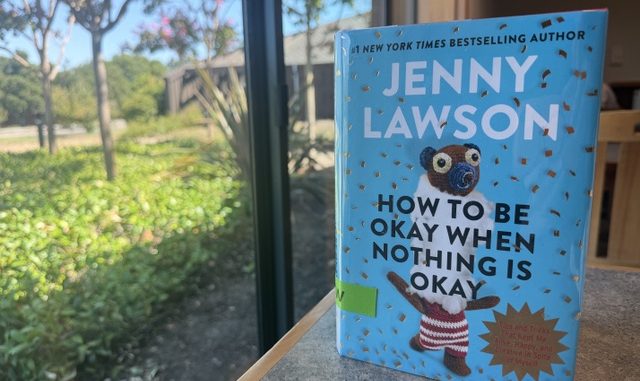
Five years later, Jenny is all grown up. In her latest book How To Be Okay When Nothing is Okay—Tips and Tricks That Kept Me Alive, Happy, and Creative in Spite of Myself she sounds calmer, more confident, and more philosophical.
Jenny has come a long way. She has survived a hellish mental, physical, and emotional torture that not many can relate to.
“I have spent a lifetime learning to operate a brain that vacillates between overthinking and total shutdown.”
Jenny is neurodivergent and has learned to cope with her demons.
“Over the years, I have hoarded a treasure chest of tips and tricks that help me manage my head and my heart. That is what you’ll find here in How to Be Okay When Nothing Is Okay.”
“It doesn’t magically fix everything as soon as you read it. I don’t think that book exists. Instead, it’s a powerful compilation of words that help me reconnect, refocus, and find joy even in the dark.”
It’s easy to believe the lie that no one is divergent like us or no one gets depressed. But the success of Jenny’s books since 2012 disproves this fallacy. On her book tours, she has loooong lines of fans.
“We are weirdos and we are legion.”
Jenny has an award-winning humor blog and has seven bestselling books. Her creative doodles became a bestselling book.
“Therapists use them for art therapy. I get letters form people who discovered me while they were in treatment because my art is used to help people understand that weird is okay and that there is room for whimsy and play and seriousness and ugliness. And that is the gift of art—both for the person creating it and the person they share it with.”
Jenny sagely shares her survival hacks to combat a range of downers, including: anger, anxiety, ADHD, arthritis, depression, OCD, memory loss, social avoidance, and suicidal thoughts.
Even if you’re not neurodivergent, Jenny’s Try to Be Happy Tips are sensible. I like her idea to make a playlist for each emotion. She listens to “Lea Salonga for crying”.
“But when I am coming out of a depression (or trying to push an impending one away), music can be incredibly helpful, so making a playlist for different moods is a wonderful shortcut for easy medicine.” She has a playlist each for when she needs to: be angry, be calm, be happy, or cry. As well as “One that is just anthemic songs and show tunes made to be sung loudly in the shower.”
Jenny’s book is a handy guide for those like me who easily lose their way and tend to believe the worst in the world. It’s easy to shrug off or ignore people like me who seem too emotional or extreme. I’ve been told I’m callous and too sensitive or pikon, at the same time. Over time, I’ve realized that that’s just how I am. And so are many others.
“You are not alone. I’m right here with you.”
But if Jenny was able to traverse the wilds of her moods and mind, and even write creatively from it, then I have hope that I can too. I’m glad Jenny endured enough to finish her books so that I have something to keep me afloat, or lift me out of my doom and gloom.
It’s not fun to see the Darkness. No one understands you when you’re in its depths. Today I tried to unhinge my mind from futility by reading chapters from Jenny’s book. It worked! Slowly, I diverted my slumpy thoughts and got out of the sinkhole of despondency—just enough to finish this column.
Since then I’ve been rereading random chapters to get me going on Slug Days. It’s encouraging to witness Jenny’s journey. She has finally come to accept that she is wired differently to serve as the Light for those who lose their way, or their Selves. I’m thankful that she has the courage to keep on going. And to keep on guiding. And to keep on being there for atypical people like me. I wish others like me can find solace in her writing.
“If there is anything you get from this book, I hope it is this: Depression lies. You are worthwhile. You are important. You make beautiful ripples in the world that you may never see, but you will make the world better just for you being in it.”
Ivy is a Jesuit-educated lawyer, a career known for its comical courtroom dramas, so she naturally became a humorist. Her comedy channel @HumorMeIvy is on YouTube.




.
.
How To Be Okay When Nothing is Okay
By Jenny Lawson
Hardcover, 270 pages, 2026.
Viking (Penguin Random House)