
Amenah Pangandaman brings visioning and dynamism to smallish Al-Amanah Islamic Investment Bank
On paper, there are easily 11 million Filipino Muslims.
After all, about 11% of the Philippine population of 117 million are Muslims. In the 2020 census, the Philippine Statistics Authority found that only 6.4% or 6.98 million of the population that year were Muslims, up from 6.0% or 6.06 million in 2015.
Yet, the share of resources of Al-Amanah Islamic Investment Bank of the Philippines (AAIIBP) is so minuscule that it is not even reckoned to the decimal point.
The Philippine financial system had total resources of P38.3 trillion or 38,300 billion. The AAIIBP assets are barely P2.6 billion—P2.58 billion as of the end of March 2026. Deposits totaled P2.18 billion, and loans amounted to P254.72 million. Also, 70% of Filipino Muslims have no bank accounts.
That could change in the coming years.
On July 10, 2026, President Ferdinand Marcos Jr. appointed former Budget Secretary Amenah F. Pangandaman as chair and CEO of Al-Amanah Bank.
Bold visioning
She is embarking on a bold visioning and a massive expansion of its lending, investment, and deposit-generating activities—mainly through an aggressive but more nuanced approach to banking. The country’s only Islamic bank is unique. It is both a bank and an investment house.
“Her appointment marks the beginning of a new chapter as AAIIBP continues to strengthen Islamic banking, promote financial inclusion, and drive sustainable development across the Philippines,” said the bank on its new boss.
Pangandaman resigned as secretary of the Department of Budget and Management (DBM), the only lady Muslim cabinet member, amid the massive flood control scandal that engulfed the agency that manages P6 trillion to P7 trillion of taxpayers’ money yearly.
A new mission
From cabinet member to CEO of the nation’s smallest government bank may seem like a comedown. It is not. Firstly, Muslims are 11% of the population. Secondly, Islam is the world’s fastest-growing religion.
Thirdly, Muslims are mostly in Mindanao, a huge region so rich in natural resources and potential and yet so detached from the central government in Manila. Fourthly, Mindanao has a huge potential which, if fully tapped, could even feed and support the whole country for years.
Finally, her years in government have given her enough traction and steely purposefulness to make a difference in the lives of Muslims, in local banking, and in the lives of Filipinos in general.
“It is no small challenge,” says Amenah. She is grateful for the challenge to repurpose AAIIBP. “It allows her to serve the Bangsamoro people,” she notes. She loves her fellow Muslims. She hails from Marawi in Lanao del Sur, making her not only Mindanaoan but a true Bangsamoro.
At the helm of Al-Amanah, she is determined to make this bank go beyond its title as the first Islamic Bank of the Philippines and make it the most accessible bank for all Filipinos.
The Philippines’ first Islamic bank
Al-Amanah was previously the Philippine Amanah Bank, established by former President Ferdinand E. Marcos Sr., by virtue of Presidential Decree No. 264, in 1973.
Philippine Amanah Bank was one of the world’s first Islamic banks, created “to promote and accelerate the socio-economic growth and development of Mindanao, particularly, the economically depressed provinces of Cotabato, Lanao del Sur, Lanao del Norte, Zamboanga del Sur, Zamboanga del Norte and Sulu” (P.D. No. 264).
In 1989, the Philippine Amanah Bank became the Al-Amanah Islamic Investment Bank, “authorized to perform and provide Islamic banking, financing, and investment services” by virtue of Republic Act. No. 6848, otherwise known as the Charter of the Al-Amanah Islamic Bank of the Philippines of 1990.
This law also gave the bank its own Shari’a Advisory Council, selected from Islamic scholars and jurists of comparative law “to offer advice and undertake reviews pertaining to the application of the principles and rulings of the Islamic Shari’a to the Islamic Bank’s transactions”.
A universal bank
Al Amanah has since received a universal bank license from the Bangko Sentral ng Pilipinas (BSP) and in 2008, the Development Bank of the Philippines (DBP) obtained 99.9% ownership of the bank’s shareholdings after acquiring shares previously owned by the national government, the Social Security System, and the Government Service Insurance System.
Rising to the challenge
Today, Al-Amanah operates on a relatively modest asset base of roughly P2.6 billion and a loan portfolio of under P255 million. But Pangandaman does not see this as a setback.
“Our modest asset base is not a constraint; it is a launchpad,” she says optimistically. “We do not need to outsize commercial megabanks to outmaneuver them.”
The former Budget Secretary, who was assistant governor of the Bangko Sentral ng Pilipinas before she joined the Marcos Jr. cabinet, is determined to make Al-Amanah grow.
Strategy
Her strategy for real growth: To capture the region’s vast unbanked population and expand their access to credit, beginning with the bank’s core clientele. “We just need to be targeted, disciplined, and double down on our natural market: Muslim Mindanao,” she explains.
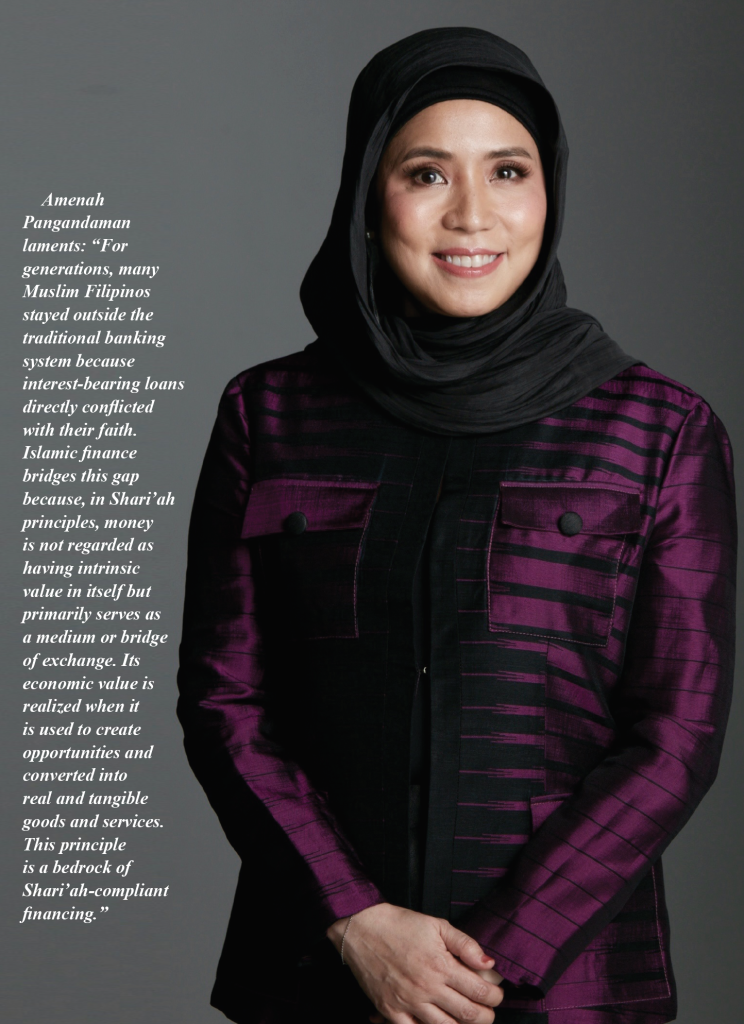
Pangandaman laments: “For generations, many Muslim Filipinos stayed outside the traditional banking system because interest-bearing loans directly conflicted with their faith. Islamic finance bridges this gap because, in Shari’ah principles, money is not regarded as having intrinsic value in itself but primarily serves as a medium or bridge of exchange. Its economic value is realized when it is used to create opportunities and converted into real and tangible goods and services. This principle is a bedrock of Shari’ah-compliant financing.”
Pangandaman seeks to capitalize on the current strengths of the bank.
Deepen the capital markets
Al-Amanah is strategically leveraging national momentum to deepen local capital markets and expand Shari’ah-compliant investment instruments across both corporate and retail channels.
To achieve this, the bank is collaborating closely with regulatory bodies, including the Bureau of the Treasury (BTr), the Securities and Exchange Commission (SEC), and the Bangko Sentral ng Pilipinas (BSP) to formulate a standardized and scalable framework for Sukuk issuances that ensures regulatory clarity and seamless execution.
Sukuk are Shari’ah-compliant investment certificates that can provide a powerful alternative means of mobilizing private and institutional capital for major public infrastructure and regional development projects, particularly across the BARMM and Mindanao in general, while supporting productive economic activity and responsible investment, without adding traditional debt burdens.
Under Republic Act No. 11439, or the Islamic Banking Act of 2019, Al-Amanah has the regulatory foundation for Islamic banks to issue Shari’ah-compliant funding instruments, including investment participation certificates and Sukuk, subject to applicable regulatory requirements and prior Monetary Board approval.
Under Pangandaman’s leadership, the bank is now set to modernize its core banking systems, back-office operations, and IT infrastructure in order to guarantee that the bank’s operational engine can process and support Sukuk transactions efficiently, ensuring full market readiness for future public and corporate offerings. At the same time, they are also conducting intensive capacity-building programs to upskill personnel, focusing heavily on equipping their treasury operations team to trade, manage, and administer Shari’ah-compliant investment securities.
While not expanding physical banks in the short term, they will concentrate on opening their Tawi-Tawi branch and a branch-lite unit in Marawi City. Branches in Basilan and Maguindanao are also in the pipeline.
Going digital
Al-Amanah is also targeting the digital banking industry, with Pangandaman intent on having an even more aggressive digital banking strategy, especially as this was her advocacy since she was Assistant Governor at the BSP.
“We are working doubly hard to roll out our digital mobile banking platform as quickly as possible. Modernizing our core systems will allow us to deliver Shari’ah-compliant mobile apps and online services faster, giving remote communities instant access to interest-free savings, remittances, and financing straight from their phones,” she shares.
Codify client profiles
Al-Amanah’s digital strategy centers on leveraging existing technology to overcome physical branch constraints across the Mindanao region.
“By integrating modern e-KYC with the PSA National ID (PhilSys), we will enable instant, paperless onboarding for unbanked individuals using a single, verified ID. Beyond serving local BARMM communities, our platform will allow us to accurately map and identify core client profiles, extending our reach to the broader Muslim population in the country,” she adds.
Digitalization will be coupled with financial literacy programs. “We want clients to understand not only how to use the platform but also how Shari’ah-compliant products work and how they can support their businesses and livelihoods. Our goal is to make Islamic banking as accessible and convenient as possible, while bringing it closer to the communities we serve.”
For all Filipinos
Beyond Muslim Mindanao, however, Pangandaman would also like to see Al-Amanah serve all Filipinos and show the general public why an Islamic bank is the one to trust.
At the heart of Islamic finance, she explains, is the concept of Amanah, which means ‘a sacred trust’.
It calls for capital to be used responsibly and productively, with a focus on fairness, shared risk, and real economic value rather than simply fixed debt.
“We are anchored in our Islamic faith, but our principles of trust and fairness are universal and applicable to everyone. So Islamic finance is inclusive despite being rooted in the principles of Shari’ah,” she emphasizes.
Bangko Sentral data shows that as of the first quarter of 2026, 28% of the country’s cities and municipalities remain unbanked or have no bank branch at all.
The regions that continue to have the greatest gaps in physical banking access in their cities and municipalities are BARMM (89%); Zamboanga Peninsula (56%); the Cordillera Administrative Region (55%); and Eastern Visayas (51%).
A captive market
Pangandaman intends to capture this market: “My goal is to apply macro-level fiscal discipline to personal banking, ensuring that finance builds tangible businesses, creates jobs, and gives every Filipino a stake in national growth without compromising their values.”
Building partnerships
Pangandaman will tap her vast network to give much-needed life to the bank. Having been the former Budget Secretary, she knows exactly what the National Government needs, and she will ensure that Al-Amanah is ready to fill the gaps.
“We will actively reinforce our position as a primary government depository. This is already authorized by our charter (Section 6, R.A. 6848). It mandates us to act as an official depository for the national government, its instrumentalities, LGUs, and GOCCs, particularly those operating in the BARMM. So we will deepen our coordination with the Department of Finance, DBM, and the BARMM Government to maximize this mandate.”
Co-financing infra
She also envisions Al-Amanah as co-financing major infrastructure projects, green energy programs, and local development initiatives across Mindanao but using Shari’ah-compliant Musharakah (joint venture) and Ijarah (leasing) structures.
While this sounds beyond reach, she believes it can be done. “We do not have to carry every large transaction on our balance sheet alone,” she says resolutely.
“We can leverage the capital strength and balance sheets of the country›s state-owned financial institutions like our parent bank, the DBP, to secure stable, low-cost liquidity from public sector agencies and state universities and directly expand our lending capacity.”
She also intends to build partnerships to strengthen the bank, noting that the Bank’s charter explicitly mandates that it accept external capital infusions.
She intends to maximize this to secure strategic equity investments from multilateral development banks, regional institutions, and established ASEAN Islamic partners.
She notes that beyond injecting fresh capital to expand the bank’s capacity, these partnerships will likewise bring world-class technical expertise, proven Shari’ah governance, and modern digital banking tools that can solidify Al-Amanah as the premier gateway for Islamic finance in the Philippines.
The way forward
“Partnership is the way forward,” she stresses. “Conventional banks and fintech companies already offer advanced technology and digital infrastructure. On the other hand, we offer direct access to our natural base and market—Muslim Filipinos.
Under BSP guidelines, conventional banks can apply for a license to establish Islamic Banking units, so rather than compete, Al-Amanah can partner with them. At the same time, our parent institution, DBP, can co-finance large-scale infrastructure, commercial real estate, and trade projects using joint venture (Musharakah) and leasing (Ijarah) structures. So as you can see, this allows conventional banks to tap into our ethical asset-backed financing while expanding Al-Amanah’s institutional balance sheet.”