
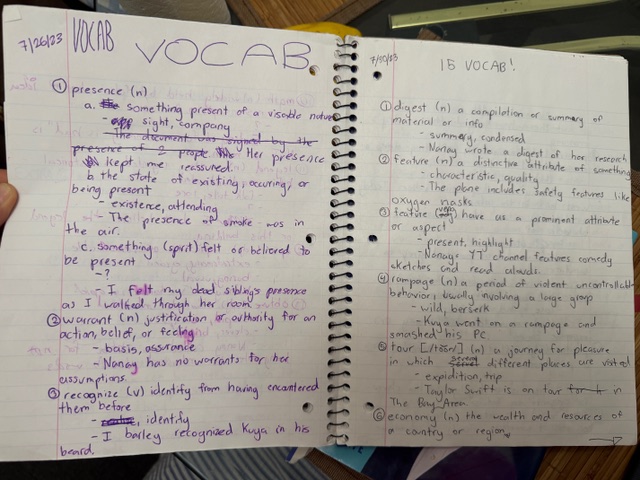
My child’s vocabulary notebook in 2023. We need to work on penmanship.
Over the weekend, my elegant friend Good Catch asked me for my favorite books or resources to build her kids’ vocabulary for the upcoming summer.
I don’t like drill books and busy work because it turns off kids from learning. I prefer to create my own scholastic torture.
It’s hard to impose good behavior on kids, so my tactic is to use what they want as a reward for finishing their unwanted task. I tried asking nicely but everything I tell them to do is unwanted. So what do kids want the most? To play video games.
Compile a list of new words
So here’s how I built my children’s vocabulary. Before my kids can play video games, they have to do vocabulary work. They choose three to ten words to write in a notebook. They look up the definition in an actual dictionary — no digital books nor devices — write the definition and pronunciation, and use it in a sentence. That’s my relaxed version.
With my first kid whom I call CB for Career Buster, I was full out Tiger Mom With No Life. CB had to write ten vocabulary words, give the definition, pronunciation, antonym, and synonym, memorize, AND recite them to me. By the time CB entered kindergarten he had a Grade 1 reading vocabulary which he immediately lost after a week of hearing his teachers and classmates say “Awesome!” for everything.
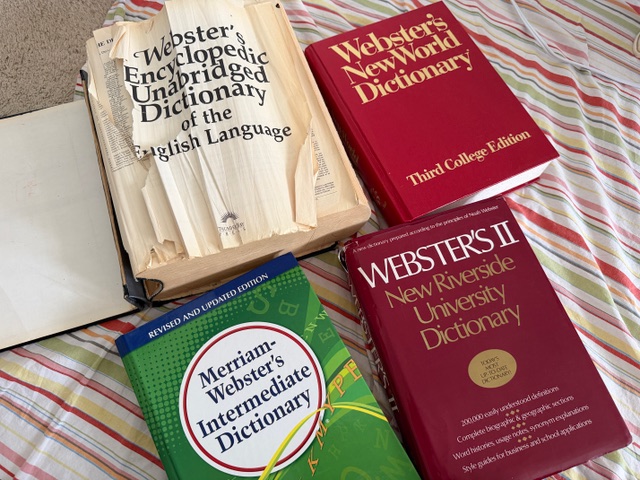
Various dictionaries in our house: unabridged, intermediate, college, and university editions.
Consult a real dictionary, not a digital dud
In looking up the definition, my kids, The Cubs, must consult a dictionary. Why? Because my Dad The Journalist said so. He told me, “When you look up a word in the dictionary, you will discover other words, which will lead to more words.”
More words indeed! The dictionary can define anything with great precision and conciseness. It’s so fun to read! That’s why I love dictionaries.
The first thing I bought in law school was a three-pound Webster’s unabridged dictionary. Unabridged means nothing was cut out so I thought I would have all the words in the world with me. It’s a tad smaller than a toaster oven so you need two arms to carry it, and one arm to flip it open. This Goliath has moved with me everywhere and sits with us at the dining table for impromptu definition questions.
But isn’t it easier to use a digital dictionary or the internet? Of course it is. But the immediate accessibility of a digital dictionary necessitates brevity and incompleteness. Don’t believe me? I used Google to define “incompleteness” and it gave me this:
Use the dictionary to find definitions or synonyms for a word
Convenience comes at the cost of missing out on the whole picture. Words have various meanings and usages, but digital definitions only give the most popular definitions.
For example, the word brief is defined by Google Drive as:
1. an adjective – of short duration
2. a noun – a concise statement of summary
3. a verb – instruct or inform someone thoroughly in preparation for a task
But my unabridged dictionary gives 15 more definitions such as:
1. scanty – as in, a brief bathing suit
2. four definitions under Law:
a. a writ summoning one to answer to any action
b. a memorandum of points of fact or of law for use in conducting a case
c. a written argument submitted to a court
d. in England – the material relevant to a case, delivered by a solicitor to the barrister who tries the case
3. under Roman Catholic Church – a papal letter less formal than a bull, sealed with the pope’s signet ring
And the definition popularized by Hanes:
4. briefs – used in the plural, close-fitting legless underpants with an elastic waistband
See how much you miss if you don’t consult a book?
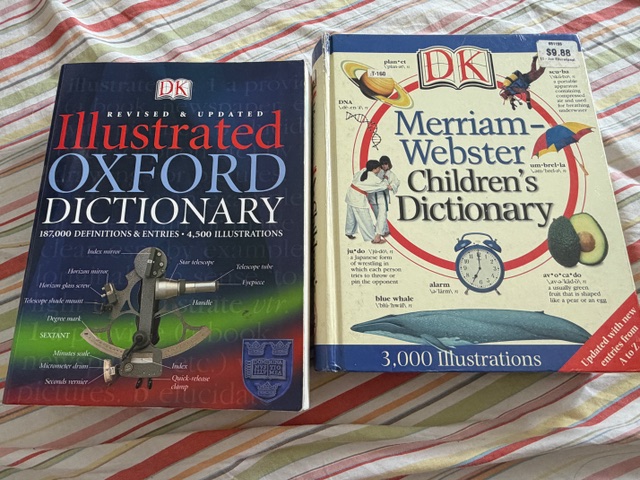
Illustrated dictionaries for teens and kids
Define words as you encounter them
The Count and The Cubs ask me all the time to define words while I’m saying them. This is a great opportunity for kids to increase their vocabulary naturally. Just today my teen asked me what “animosity” meant while we were discussing stepmothers and daughters.
Though I want The Cubs to consult a dictionary, real-time kid questions should get an immediate answer to encourage further curiosity. If they ask me what “Inception” means while we’re watching the movie “Inception” I will define it on the spot to enrich their movie experience.
When The Cubs got older and they asked me what a word meant, I would ask them what they think it means, if there are contextual clues. Sometimes the older kid will define the word for the younger one, who must then check the dictionary to verify if the definition is correct. The younger one reads the definition out loud so that we all learn it, and the older one has the satisfaction of being right — most of the time.
What words do I learn
Don’t memorize big words just for the sake of sounding smart. Only lawyers are licensed to be that annoying.
The best way to increase your vocabulary is to read. An hour of reading is required in my house for every hour of video games. When my kids, The Cubs, were younger we also had nightly storytimes, which I later ruined by asking them “What is a fairy tale?”
Nonfiction is a great vocabulary builder. I tell The Cubs to read one nonfiction a week “so you’re not ignorant”. It can be any topic of interest as long as it’s based on facts. From their reading, they will see new words that they can choose for their vocabulary notebook.
When The Cubs insist “there are no new words” I give them ten. During COVID when everyone decided they were going to be YouTubers, I gave them 20 vocabulary words they use often, like: subscribe, viral, copyright.
To burst their inflated egos, I sometimes quiz The Cubs to define common household items they think they already know. It’s so satisfying to see them struggle for words to define shirt, button, apple. After a convoluted sputter they have to check my Goliath dictionary to see the correct definition.
If you hardly read, just go to the source. When CB was in elementary, I let him choose words from his Illustrated Children’s Dictionary. Pictures make vocabulary building less boring.
Words occur in everyday life. The point is to question what you assume you know by trying to define words as you go through your day. What is sleep, alarm, soap, or routine? Can you define desperation?
How to remember vocabulary
Like names, the best way to remember new words is to use them. That’s why it’s better to learn words you naturally encounter. Even if you only know basic words, you will still increase your vocabulary.
My Webster’s college edition gives the word “basic” four definitions as an adjective— which includes geology and chemistry — and two as a noun. Google only has three definitions. Then right after it, there’s the acronym BASIC, a computer code. Not so basic after all.
When you learn new words, write it down. When CB was in elementary, his class wrote vocabulary words on small index cards with a definition on the front and their drawing of it on the back. This became their flashcards to test themselves and share with the class. By the end of the semester, they learned over 3,000 vocabulary words.
The point of building a vocabulary is to astound your audience. Whether you write or speak, you sound accomplished. When you use an impressive word correctly it presupposes that you have the ambition to improve yourself, the diligence to achieve your goals, and the capacity to level up your skills. And that makes you more intelligent.
Intelligent people likely lead better lives because intelligence informs your decisions. And decisions dictate your life.
Ivy is a Jesuit-educated lawyer turned columnist and book reviewer. For the latest Silicon Valley books follow me @IvyDigest on YouTube.