
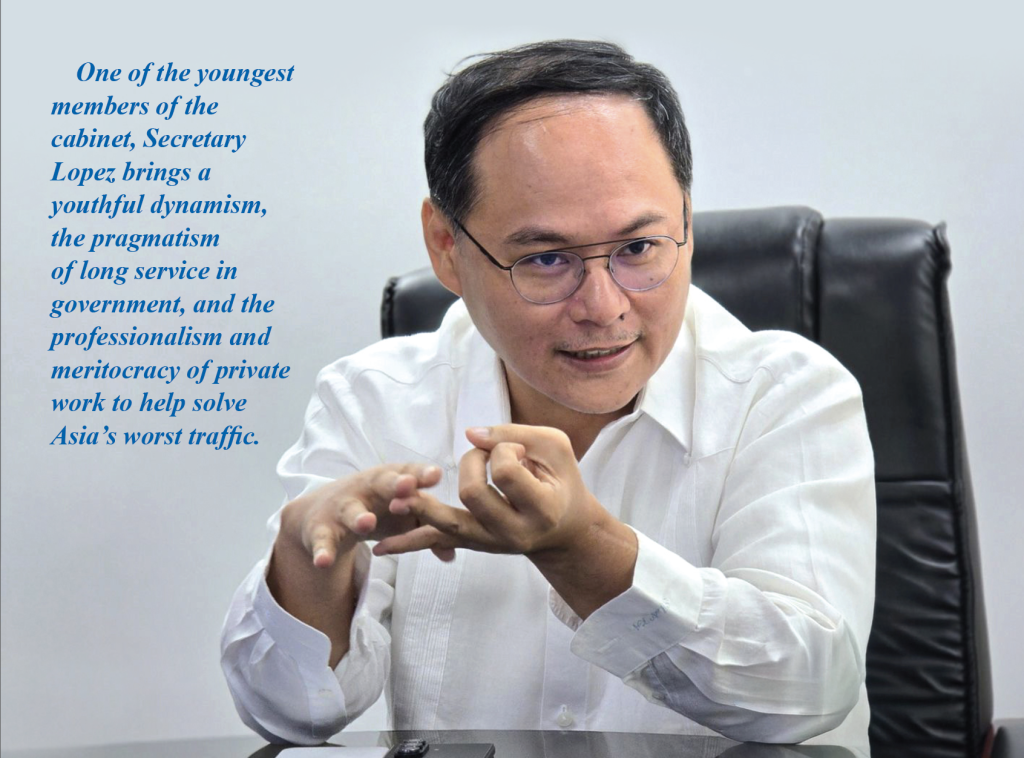
By Secretary Giovanni Z. Lopez
Department of Transportation
(Presentation before the Management Association of the Philippines, April 8, 2026)
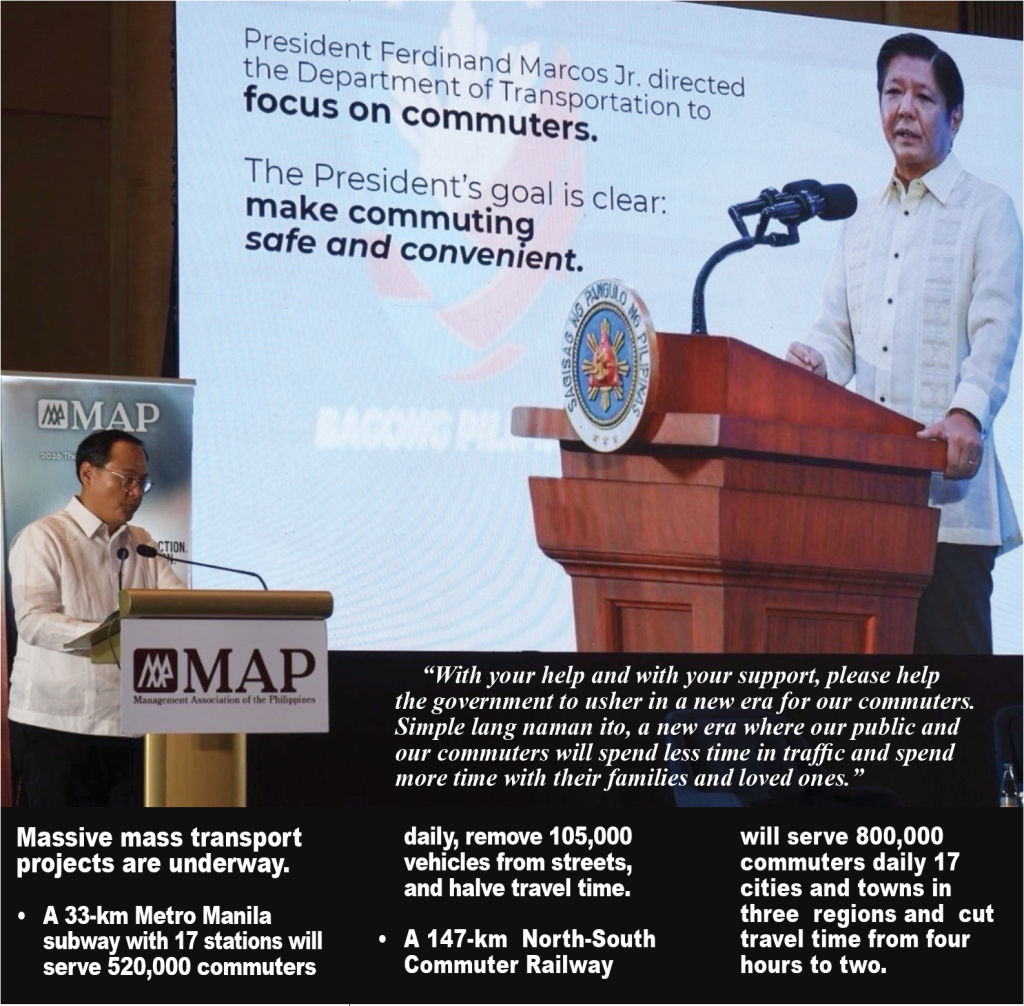
Make commuting safe and convenient.
Following this directive, the Department of Transportation is focusing on what we call commuter-centric projects that will encourage our private motorists or private vehicle owners to use the public transportation system.
Based on the 2025 Hong Kong Traffic Index, the Philippines became the most congested country in Asia. That was last year.
Interestingly, based on the same report, it was said that the average Filipino motorist or commuter in one car in a year loses almost six days because of traffic. That was stated in the report. So, halos isang linggong pag-ibig po ang nawawala sa atin pagdating sa traffic just last year.
P1.3 trillion a year lost from traffic
And based on the 2019 JICA Transport Master Plan, the Philippine economy suffered a loss of P1.3 trillion per year. An amount that could have built over half a million public classrooms, over 2,500 provincial hospitals, or over 4 million irrigated hectares of land.
This life threat is a crisis that every Filipino motorist or commuter faces every year. But beyond these glaring statistics of economic loss, there is one important matter. I think, if not equally, but more importantly, affects every Filipino.
This is, we Filipinos lose time when we are stuck in traffic. Precious time that could have been spent with families and more productive activities. So our end goal is now defined.
The President’s mandate
Simple lang po ang utos ng ating Pangulo sa Department of Transportation, that is bring back precious time to the people. We have to continue to improve connectivity and mobility of people and goods through dependable public transport and reduced travel time.
Ang sabi ng Pangulo sa amin two things: Safe time, safe on daily expenses. Simple lang po. Yan po ang aming layunin, though simple, napakahirap pong gawin.
So the Department of Transportation is now implementing massive infrastructure projects, such as the subway, the NSCR, the North-South Commuter Railway, then we have the MRT-7, then we have the existing MRT-3, Line 2, Line 1.
Hoping that this rail system will become one of the public system’s preferred choices of travel in the future. Because these are all must-transport systems.
Subway
So let me start with the Metro Manila Subway.
The Metro Manila Subway is a JICA-funded project. It is a 33 km rail line with 17 stations connecting 6 cities in Metro Manila. Let me start with saving time. From Valenzuela all the way to Terminal 3 in NAIA, usually it takes us, on a good day, siguro sabihin nating dalawang oras or 1 hour and 30 minutes. This time with the subway, almost 40 minutes.
From Valenzuela, where the depot is, all the way to Parañaque, again, by land, almost 2 hours. This time, once the subway becomes operational, around 40 minutes. So we’re saving time, and we’re saving expenses.
And once this project becomes operational, we’re expecting that the commuters who will benefit here are 590,000 commuters daily. Put differently, 590,000 commuters.
Sa isang sasakyang may limang pasahero, divide it by 5. So, more or less, I think that is 108,000 cars. More or less, thereabout.
So 108,000 cars, less cars, no doubt. Recently, the progress rate of our subway is, we’re hitting 26%. And we’re hoping, we’re targeting that the full operation of our subway will be in the second quarter of 2031.
First station by 2028
But in the first quarter of 2028, at least for the first station, from the depot in Valenzuela, all the way to the Quirino station, we can show the path from the depot to the Quirino station. We can see how the bagon, the train set, from the depot all the way to the first station.
Second is our North-South Commuter Railway.
This is both funded by ADB and JICA. It is a 147-kilometer rail line with 35 stations connecting 3 regions, 17 cities, and 6 municipalities across Luzon. So this is all the way from Clark International Airport to Calamba, Laguna.
So, from the North-South Commuter Railway, we are expecting once this gets operational, 800,000 commuters who will benefit every day.
And we can expect partial operations of this NSCR from the segment of Malolos all the way to Valenzuela in 2027. Kakayanin po natin yan at parating pinapaalala ng ating Pangulo na we have to do that, the partial operations.
Valenzuela to Clark by
2028 five hours to just two
Now, from Valenzuela all the way to Clark, we hope we can do it by 2028, at least for those two segments. Now, we have to show the reduction of travel time.
From Clark Airport all the way to Calamba, Laguna, more or less, we’re talking about four hours, yun kapag wala pa hong traffic. This time, we can expect more or less around two hours because of this.
Of course, we are also hopeful and happy to note that the MRT-7, the one all the way from San Jose del Monte, Bulacan, to North Avenue, the first 12 stations, po, from Sacred Heart to North Avenue, we can expect partial operations, commercial operations, by the second quarter of 2027. We have 14 stations here.
The first 12 stations, po, from Sacred Heart all the way to North Avenue, we can expect partial operations in the second quarter of 2027. And we’re expecting that the passengers who will benefit here are more or less 300,000 passengers.
Again, if we divide that by five, that is, I think 60,000, that is 60,000 fewer cars on the road. And this will decongest the traffic in the Commonwealth, simple as that. Ang hirap po ng traffic sa Commonwealth. You know, when I started as an acting secretary, one of the first memoranda that I issued was that the senior officials of the Department of Transportation must take the public commute at least once a week.
The pain of commuting
And we’re still doing it now. So for the first time, and the first time we commute, especially for me, I live somewhere in the Commonwealth. I leave the house at 6 a.m. I reach my office at 9 a.m. So based on that experience, I was forced to include the other senior officials. Mahirap naman po ako lang po nagdurusa, so dinamay ko na rin po sila.
So hopefully with this project, by 2027, our commuting experience will be better. Of course, the existing MRT-3, ngayon po ang MRT-3 natin, we can say that it’s reliable, convenient, and affordable. And on average, we’re catering to more or less 480,000 to 500,000 commuters daily. And we’re improving the stations of MRT-3.
And just I think recently, with the help of Sumitomo, we awarded Sumitomo to continue. Sumitomo is our maintenance provider for MRT-3. So just the name Sumitomo, sure of the reliability of our maintenance of MRT-3. We are also doing, we’re introducing initiatives in our MRT-3 in order for us to promote modal shift from private transportation to the public mass transportation system.
Vince Dizon’s automatic
fare collection
Just last year, Secretary Vince introduced what we call the Automatic Fare Collection System. In other words, this is just a cashless payment. So ngayon po magagamit natin ang e-wallets, you can use your credit cards, you can use your debit cards, and other cashless payments.
So, since we introduced this initiative, over 5.4 million people have benefited from this cashless payment. Then we continue to modernize our railway station. We started with the Quezon Avenue station. Malapit na po matapos yan.
We improved the way finding, we improved the escalators, we improved the elevators, and this time around, we’re going to put up barriers for the safety of our passengers. And I think it will be done by May with the Quezon Avenue station, and we will continue to do it with the other stations of MRT3.
Four-car train sets
Last year, we also started deploying what we call four-car train sets. Again, this initiative was started by Secretary Vince Dizon, and this was made possible because of the cooperation of the owners of Dalian Trains. This time, we’re deploying Dalian Trains. We started with three-car train sets, and hopefully, within the year, we can deploy more Dalian Train sets.
The importance of this skip process, or this four-car train process, is that we usually deploy this during peak hours. We cannot avoid the queuing of MRT-3, especially nowadays. Magkakaroon at magkakaroon po ng pila yan, especially peak hours. Because 5pm, lahat diyan, mag-uuwian. But what we can avoid, and what we can, you know, the government does, is our reaction time.
Right now, I think there’s still room for improvement. But once there’s a queue in our station, we deploy what we call a skip train. And usually, these are four-car train sets. So, in just a matter of 20 to 30 minutes, nauubos po ang pila.
And we’re going to introduce the same concept in our busway. Again, we already identified the stations. Ortigas, Cubao, Magallanes, Ayala. Every 5 pm, 6 pm, you know, the line there is like they’re building up.
So we just have to react quickly by providing what we call skip trains and skip buses. So, nakaabang lang. Just in case may queuing, all they have to do is pick up the passengers.
Fare discounts
Just recently, because, you know, in order to mitigate the problem in the Middle East, the President instructed DOTR to give fare discounts. So we reduced 50% fare discounts in MRT-3 and LRT2. So, in just one week, over 4 million commuters benefited from this discount.
In other words, over 4 million commuters were able to avoid lost time in traffic. Over 4 million commuters were able to save money and free up resources for other essential needs. Nakatipid po sila.
Likewise, we have the
PAMILYA Pass 1+3 Promo.
Again, this is the initiative of Secretary Vince, if I may say so. Simple lang po ito. Every Sunday, you bring your family, group of 4, or magbabarkada kayo, and all you have to pay is just for one person.
Then we introduced what we call the White Beep Card for the PWD, senior citizens, and students. This is an automatic 50% discount.
So, still, up to now, we can use the White Beep Card.
So, more than what we call making sure that our public transport system is affordable, it is also imperative for the department to make sure that our infrastructure brings convenience and mobility to our commuters.
In other words, when you say convenience, there must also be interconnectivity and interoperability. And this is where the Common Station comes in. A unified terminal that ensures the smooth transfer of the passengers of MRT-7, MRT-3, Line 1, and eventually the subway.
Common station
Once this Common Station becomes operational, we’re expecting 1.5 million passengers daily. And we’re hoping to have this finished by the second quarter of 2027. There was a delay at the Common Station. Last year, we had to terminate the contractor. And we had to talk to LRMC and Sumitomo to take over the construction of the Common Station. And we’re targeting really the second quarter of 2027.
Why? For the simple reason that the partial operation of MRT-7, 12 stations, will also start in the second quarter of 2027. Again, masasayang po yung proyekto ng MRT-7 if there’s no connectivity to our MRT-3 and our Line 1.
Road Sector
Now, for our road sector, let me start with the EDSA Busway. I think this is the favorite infrastructure project of Mr. Eddie Yap.
Since 2020, the EDSA Busway Station has steadily earned the trust of our homeowners. For 2025 alone, we cater to over 60 million passengers. Underscoring its reliability, underscoring its efficiency, at least for commuters.
The EDSA Busway Station complements our MRT-3. The same line, but this time with more bus stations. We continue to improve our EDSA Busway Station. Of course, with the help of our private partners like SM.
SM effort
I don’t know if you noticed yet, but the northbound busway station in Ortigas. I think SM recently opened it quietly last week. And we want to extend our gratitude to SM. But last year, we started our Kamuning Bus Station. Replacing what we call the infamous Mt. Kamuning Station. May bago na po tayo ngayon.
And it was inaugurated no less than by the President. This time, as a form of template, we make sure that our EDSA Busway Station has elevators. And not only elevators, but we also make sure that there must be PWD wheelchair lifts exclusive for our senior citizens. Meron po yan sa ating EDSA Kamuning Station.
Three more stations
And next year, in the first quarter, we’re going to add three more stations. One in Cubao, one in Magallanes, one in PITX. Again, the same format, the same template, the same configurations.
We started introducing also what we call the cashless payment sa busway natin. You can use your GCash for the convenience of commuters. In partnership with DICT, meron na po tayong WiFi sa lahat ng busway stations natin.
We’re coordinating right now with the bus operators if they can also put WiFi in their respective buses. By the way, at our MRT-3 stations, we have free WiFi. And we’re working with DICT if we can, you know, put WiFi also in our train sets.
Then, on the southern part of the EDSA busway station, thanks to Secretary Vince and DPWH, there’s a massive upgrade on the southern part. And it is part of what we call the EDSA Rehabilitation Project. If you notice po, yung kalsada natin ngayon diyan, puwede natin masabi para pang-runway.
Part of, you know, the programs of DOTR is also what we call the Active Transport. This program is more of, you know, the personal mobility of our commuters. And it is part of how we can sustain transportation.
So the department has constructed around 1,000 kilometers of cycleways nationwide. But what I want to emphasize on this Active Transport project is that we’re starting to build, as part of our bike lane, what we call end-of-trip facilities. Kasi yun po yung nagkukulang.
And what are these end-of-trip facilities? We started with two already, end-of-trip facilities. Simple lang ho. We will give to the commuters, the cyclists, a facility where, you know, once they do the cycling, they have this facility where they can take a shower later on.
So we’re doing it right now as part of our Active Transport program. If we do bike lanes, dapat mayroong end-of-trip facilities pagdating sa dulo. While we can provide for the facilities, the shower, and everything, we cannot provide for the soap, the shampoo, and the towel.
1,100 bike lanes nationwide
So at least nililinaw po namin. Especially so when we deal with the LGUs. Baka naisip kasi nila, it’s a package deal. So we have to be specific that we can give the facilities, the shower, but not the consumables. Right now we’re within the year. Hopefully, we can target our goal of around 1,100 bike lanes nationwide.
Moving forward, building high-capacity transportation as well as commuter and pedestrian-friendly spaces will help solve traffic problems in Metro Manila and eventually make the metropolis a conducive environment.
Long term solutions
As we always say, the long-term ultimate solution to traffic is always mass public transit. If we have a mass public transit system, we can move more people. And that capacity is very crucial to reduce the number of cars on the road.
With your help and with your support, please help the government to usher in a new era for our commuters. Simple lang naman ito, a new era where our public and our commuters will spend less time in traffic and spend more time with their families and loved ones.
And we cannot do this alone. We need your help. We need the help of the private sector to realize this project. So please, together, we can make this happen.
Magandang hapon po sa inyong lahat.