
By TONY LOPEZ
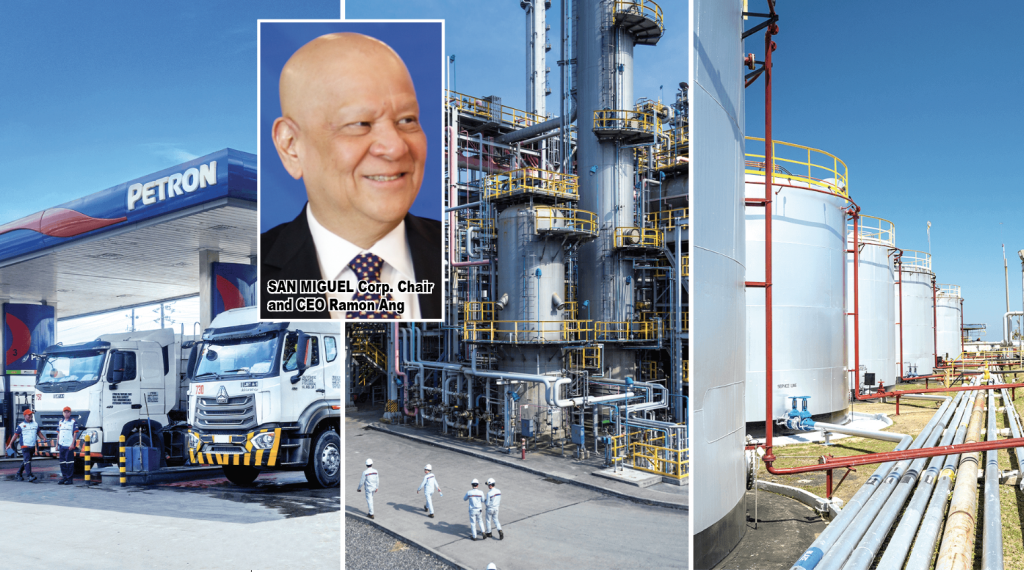
San Miguel Corp. chair and CEO Ramon Ang has revived his offer to sell Petron Corporation back to the government.
RSA first made the offer in 2021 when government planners noticed that its mother company, San Miguel Corporation, has made such a good business out of Petron.
The sentiment grew louder after the United States and Israel mounted an all-out war against Iran. By this writing, the US and Israel have hit more than 11,000 military targets, including a girls’ school where more than 150 kids died, casualties of what is clearly an illegal, unprovoked, and an undeclared war. The US also claimed to have obliterated Iran’s navy, with more than 150 vessels damaged or destroyed.
In retaliation, Iran has taken control of the Strait of Hormuz, the narrow (33 kms at its narrowest width) body of water through which passes 20% of the world’s crude oil and gas supply. Iran owns the north side of Hormuz, friendly Oman the south. It is reported Iran charges up to $2 million per oil tanker for a tanker to be allowed passage. Only tankers of friendly countries are allowed passage. The policy effectively chocked off a vital oil supply line that feeds 80% of Asia’s oil and gas needs.
Iran’s stranglehold sent prices of crude, refined oil products, and their derivatives like chemicals, fertilizers and even helium used in semiconductors zooming to unheard of levels. The world is on the brink of a recession—all because Donald Trump wanted to prove he is the most powerful person on earth—and in the universe.
To prove his firepower, Don Donald has dispatched additional troops—3,500 marines, on top of the 50,000 already in the area.
Will he invade Iran? Nobody knows. Not even Donald himself. This war is like theater. Everything depends on the antics and the mood of one man. Meantime, the worst case scenario is for oil to hit $200 a barrel—three times pre-war.
Amid the needless suffering of billions, Pope Leo, an American, has waded into the war debate delivering the strongest papal rebuke yet on any leader, living or dead.
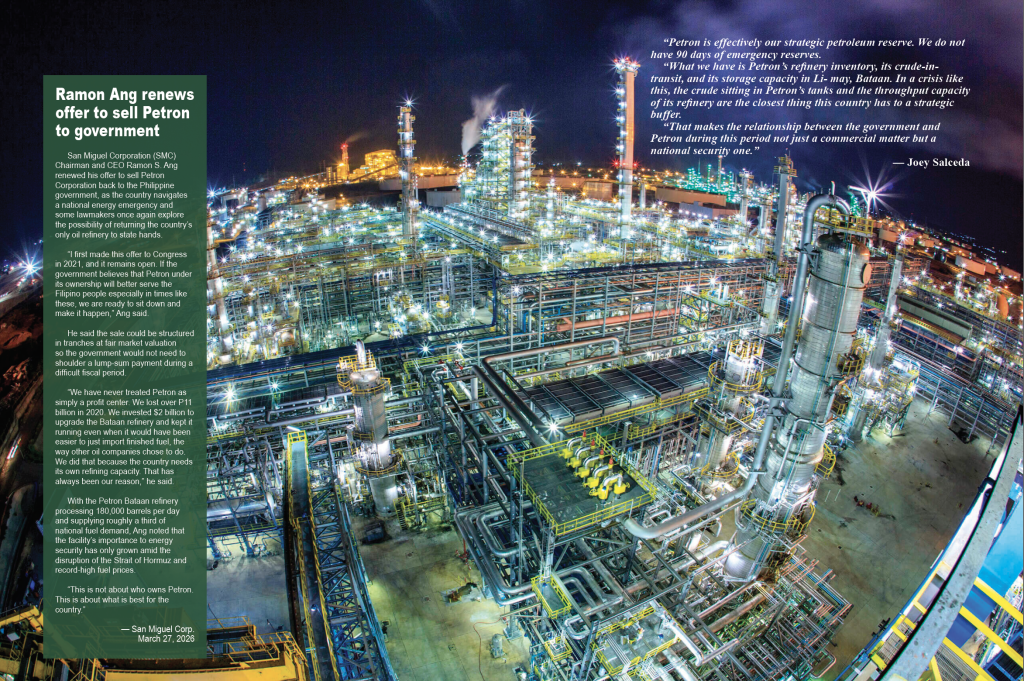
Amid the uncertainty, Petron has become such a valuable strategic asset. The country’s only oil refinery can process 180,000 barrels of oil per day. It has about 35 days worth of oil supply, meaning the country can probably last a Donald war until June 30, this year, without suffering from serious fuel shortages.
With up to 39% market share and 1,800 retail stations, Petron can dictate prices of refined petroleum products. Not surprisingly, Petron’s retail prices of oil products are P5 to P10 per liter cheaper than its competitors, all of them hand-to-mouth importers for lack of storage and refinery.
Petron ended 2025 with a net income of P15.6 billion, surging 84% from P8.5 billion the year before, driven by stronger domestic sales, improved refinery performance in both the Philippines and Malaysia, and lower financing costs resulting from tighter cash management The 84% profit surge was despite a 6.7% drop in revenues to P810 billion (from P868 billion) due to lower oil prices.
Expect Petron revenues to reach a record P1 trillion, enabling parent company SMC to scale a new high P1.7 trillion in revenues, the largest of any local company.
Petron is the Philippines’ only petroleum refinery. Its close competitors Shell and Chevron shut down their refineries years ago.
Petron, under CEO Ang, instead of closing its Bataan facility, launched an aggressive expansion and efficiency optimization. He invested $2 billion to make Petron’s refinery one of the most modern, most efficient and most profitable in the region. It gets its crude for local refining from Saudi Aramco. Its Port Dickson Refinery in Malaysia gets its crude from Exxon Mobil and Shell.
“The company believes that its competitive advantages include organization, technology, assets, resources and infrastructure. The company continues to implement initiatives aimed at improving operational efficiencies, managing costs and risks and maximizing utilization of its assets and opportunities,” says Petron in its recent P32-billion bond offering.
Petron’s share price rose to as high as P3.54 on March 9, from its Feb. 27 closing of P2.74 up 29%, before settling at the March 27 price of P3.03 per share, up 10.6%.
Relates analyst Joey Salceda about Petron:
“When the United States and Israel struck Iran in late February 2026, Brent crude spiked past $90, then past $130. Dubai crude is at $131 as of this writing. RON 95 gasoline in Metro Manila is approaching P100 per liter. Diesel has blown past it.
“But look at what the DOE price monitoring data also show. In the week of March 10 to 16, Petron RON 95 in the NCR was P70.50 per liter. Shell was at P76.70. Caltex at P75.30. The independents clustered around P68 to P73.
“Petron, the only company in the Philippines that refines crude domestically, was within two pesos of the cheapest brands. Shell and Caltex, which import finished gasoline from Singapore, were six to seven pesos above.
“When you import finished product, you pay whatever Singapore charges that week. When you refine domestically, you process crude contracted before the spike, add value here, employ workers here, and sell at a cost structure that does not fully track spot prices in real time. The refinery absorbs part of the shock.
“The survival of that refinery is not an accident. In 2021, when Congress drafted the CREATE Act, I authored Section 295(G) of the amended Tax Code. The provision defers duties and taxes on crude oil imported for domestic refining to the point of product lifting, not at the border. The tax is not waived. It is collected when the refinery sells products.
“Petron is effectively our strategic petroleum reserve. We do not have 90 days of emergency reserves.
“What we have is Petron’s refinery inventory, its crude-in-transit, and its storage capacity in Limay, Bataan. In a crisis like this, the crude sitting in Petron’s tanks and the throughput capacity of its refinery are the closest thing this country has to a strategic buffer. “That makes the relationship between the government and Petron during this period not just a commercial matter but a national security one.”