
The world is in turmoil. Never ending wars are taking place in a number of areas across the globe, with no end in sight.
Major armed conflicts are ongoing in the Middle East, Eastern Europe, and parts of Africa, in particular, Russia-Ukraine, US-Israel-Iran (impacting Lebanon/Gaza), Sudan, Yemen, Syria, and Myanmar, resulting in severe humanitarian and economic crises.
Most disruptive and debilitating of all is the United States and Israel vs. Iran war, now on its second week.
“This time is different in this crisis – it is not just about higher oil prices but a potential looming energy shortage, with the Philippines and Asia disproportionately hit by a prolonged Strait of Hormuz closure,” says an analysis by Michael Wan, senior currency analyst of MUFG Bank Ltd., a global financial group. (See pages 10-14)
The Philippines is hit in three aspects on the energy front: crude oil, refined petroleum products, and natural gas and associated products.
The Philippines imports 95% of its oil from the Middle East. Asia is experiencing shortages of refined petroleum products—jet fuel, diesel and gasoline.
“Virtually all of the natural gas supply from the Middle East is subject to the Strait of Hormuz chokepoint especially from Qatar. For the Philippines, imports of LNG are not very meaningful today, but we note 91% of propane/LPG imports and 35% of imports of natural gas liquids (inputs into the chemicals industry) are from the Middle East,” says MUFG.
SMIC a standout
Amid the crisis, one Philippine conglomerate stands out for its resilience and ability to thrive in nearly every major challenge to business and the economy—SM Investments Corp.
The holding company of the late legendary taipan Henry Sy Sr., SMIC is the Philippines’ biggest company in market capitalization ($14.6 billion), banking (2,545 branches; $125.9 billion assets BDO and Chinabank), retailing ($5.234 billion sales; 89 malls; 4,831 retail outlets); and property (SM Prime market cap: $10.5 billion). SMIC is one of the biggest in terms of assets ($89.8 billion), profitability (P90 billion), and even in education (NU, with more than 80,000 students).
Three reasons for resilience
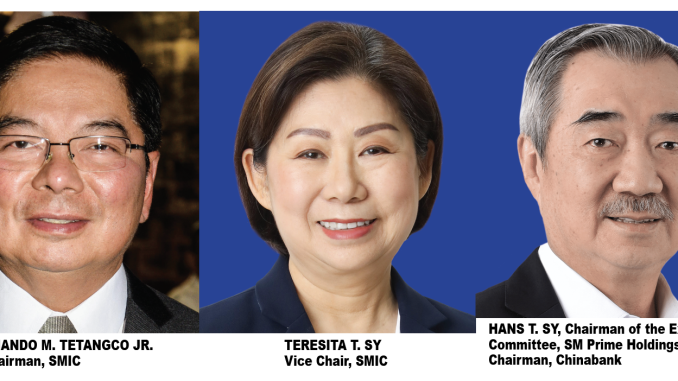
Three qualities explain resilience of the SM Group: Discipline, hard work, and humility. Also, SM Group’s faith in the Philippines is writ in stone. One rule whenever there is a crisis, says Hans Sy, president of SM Prime, “understand the situation before making any decision.” “In my case,” he explains, “I try to be pro-active, not reactionary. We try to anticipate problems.”
Hans is the man behind the awesome success of two of SM Group’s come-from-behind enterprises—China Bank, which zoomed from out of nowhere to fourth largest bank under his helmsmanship, and the National University, which grew from 1,000 students in 2008 to 80,000 today.
Downturn expected
For her part, SMIC Vice Chair Tessie Sy says on the current war-induced crisis: “We are still assessing the situation and checking our operating cost. We anticipate a weaker market in the next few months.” “We expect a downturn in consumption,” Hans agrees, “but it will recover.” In any case, he stresses, “we have solid finances. We are not overborrowed.”
SMIC Chair Amando Tetangco Jr., one of the country’s best central bank governors, cites three coping mechanisms:
“First, each of our business units maintains a conservative balance sheet that enables us to pursue our strategy, including planned expansions, while preserving the flexibility to seize opportunities that arise during challenging periods.
“Second, our businesses serve a broad spectrum of consumers across different price points. This diversity has proven to be a source of resilience—as we saw during the pandemic when our ecosystem continued to perform even amid significant disruption. “Third, we remain firmly focused on long-term growth. We recognize trhat there will be inevitably be bumps along the road, but our businesses are built with the discipline and preparation needed to navigate them.”