By Tony Lopez
Amid a grim economic environment, the Philippines’ oldest conglomerate, Ayala Corp. (AC), still manages to create excitement across significant sectors of business.
Ayala’s partner for more than half a century, giant Mitsubishi of Japan, is pouring $700 million in equity into the conglomerate. That’s P44 billion of almost free cash. (See related story on pages 28-29)
Ayala’s payments app, Mint’s GCash, has just raised about P61 billion for the stock market following the biggest-ever Philippine IPO.
The Mitsubishi and GCash initiatives, which instantly raised over P100 billion in just a few days, are a colossal vote of confidence by investors, local and foreign, in Ayala, in its businesses, in the country and in the Filipino.
There is more.
Over the past few years, Ayala has quietly and slowly invested heavily in sectors and businesses that will define the life and lifestyle of the Filipino, brighten his future, and strengthen his country for the balance of the 21st century.
The businesses have a name—social infrastructure.
Social infra encompasses anything and everything that will uplift the Filipino spirit—education, health, sustainability, building communities. These are also ingredients of why countries prosper.
Three pillars of social infra
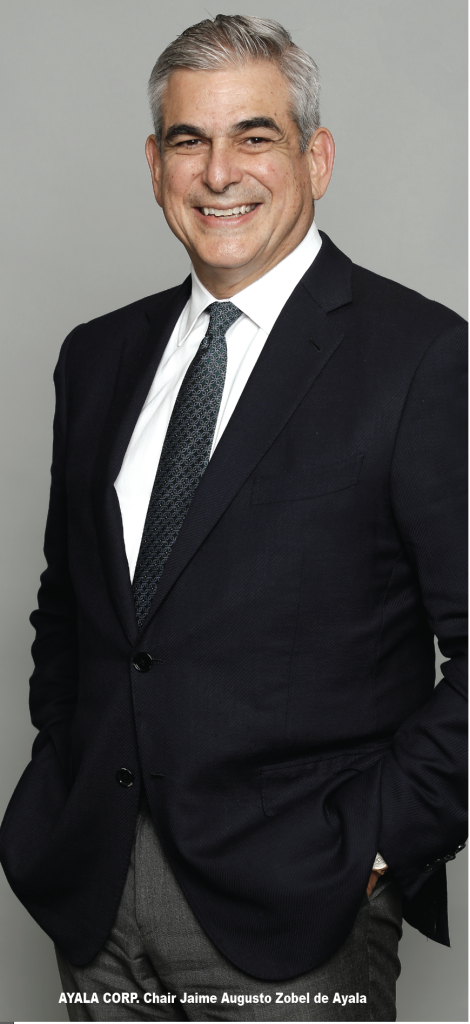
AC Chair Jaime Augusto Zobel de Ayala (JAZA) explains “Alagang Ayala”: “If you look at how countries move forward, there are three basic pillars. No. 1 is education for the future. No. 2 is making sure citizens are healthy. No. 3 is ensuring that they earn an income.”
Three basic things make the Filipino complete—quality education, strong health, a decent income. They are also the ingredients that make a democracy like the Philippines vibrant, dynamic, sustainable, and future-proof.
An educated Filipino chooses the right leaders. He chooses good over evil. He has moral mooring. A healthy Filipino makes himself productive and extends his life expectancy. A decent income ensures access to both good education and good health. Such people make a solid foundation for a nation’s social infrastructure.
Ayala, a nation builder
So when a conglomerate like Ayala focuses on social infrastructure, it makes itself a nation builder. It makes itself last longer. No wonder Ayala is the oldest conglomerate. Its heritage and track record of 192 years are unrivalled.
The best capital of a corporate colossus like Ayala is not money. It is people. Good people. Professional people. Ayala has lasted for nearly 200 years mainly because of two things—one, the good genes of its founders, transmitted thru more than six generations; and two, the unmatched, enviable professionalism of its management team, many of whose key players are non-relatives. Strong professionals make for good governance.
Good governance inspires confidence
“Investors do not invest merely in balance sheets,” said Securities and Exchange Commission Chair Francis Lim when he addressed the Ayala Group Sept. 10, 2026. “Capital flows where investors have confidence that information is reliable, boards are accountable, minority shareholders are treated fairly, and management acts in the long-term interests of the company—not simply in the interest of a few,” Lim added. “This is why good governance is not an administrative burden.”
JAZA offered Paolo a platform
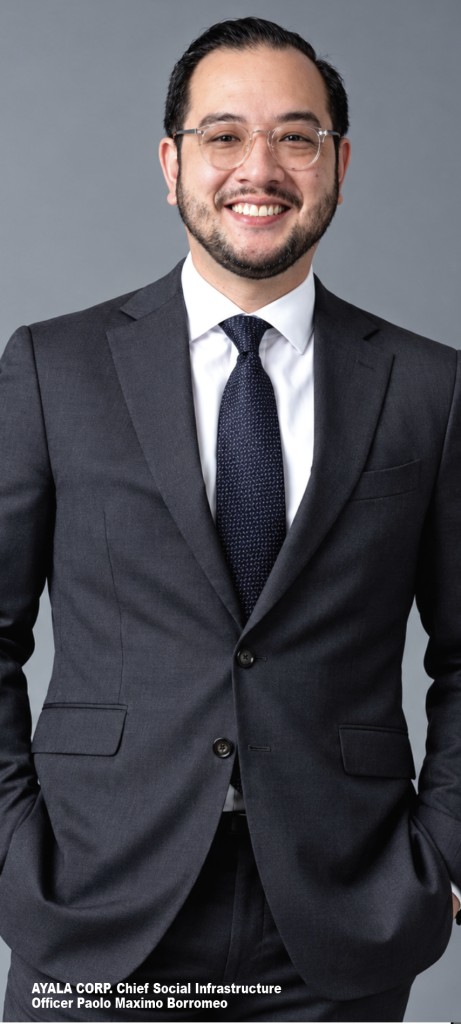
JAZA invited Wharton-educated whiz kid Paolo Borromeo, now 49, in 2012 to join Ayala as head of corporate strategy and development. Paolo started in professional management and consulting when he was just 34.
The Ayala head honcho gave him a platform on which Paolo could execute his vision and where the conglomerate’s reach and resources could help fill the gap in the country’s social infrastructure—starting with health care, a womb-to-tomb business. At the same time, Paolo moved into education.
“I looked at the Ayala businesses,” recalls Borromeo. “You can grow land. You can grow banking. You can grow telecoms. But it is far different when you invest in heart and education. You are able to help a lot more money. You are investing in people.”
It so happens that investing in people is also a basic philosophy of JAZA. The Harvard-educated Ayala chair is also strong on innovation.
P20 billion invested in health, education
With Borromeo’s firm stewardship, Ayala has invested over P20 billion in health care and education. “Social infrastructure is the infrastructure that builds people and that, in turn, leads to a stronger and more prosperous nation,” stresses the CEO of the Ayala Group’s social infra business.
6.5 million helped by ACHealth
Ayala’s AC Health has touched or helped or healed 6.5 million Filipinos thru its seven hospitals, 18 multi-specialty centers, more than 350 clinics, and nearly 900 drug stores under the Generika Drugstore and St. Joseph Drug brands. The group also has a line of pharmaceuticals.
Ayala’s education thrust is carried out thru its I”People—a joint venture with the Yuchengco group. The education network includes quality colleges and universities like Mapua University, Mapua Malayan Colleges, National Teachers College, APEC Schools, and the University of Nueva Caceres.
Quality basic education
Ayala’s CENTEX programs enhance quality basic education. The pilot CENTEX Digital Education has improved the quality of education of 1,600 pupils in Grades 4 to 6 in nine public elementary schools. After three months of tutoring, the average math scores of pupils leaped to 56 percent, from 27 percent, a doubling. DepEd is so enthused with the program that it is being expanded to cover 22,500 pupils in 60 schools in Zambales alone.
“CENTEX program is something that we’ve been very encouraged about, especially with results that we’re seeing in communities where we deployed CENTEX,” enthuses Paolo.
“CENTEX really is about training teachers, investing in their own upskilling, investing in, you know, the classrooms and the learning laboratories, technology, laptops, you know, some of the basic things,’ he relates, “but it’s working with the DepEd and it’s working with the local government units to try to upgrade those systems.”
In San Marcelino, Zambales, Paolo says, “we’ve been very, very encouraged about the results, a real uptick in the learning capability of students, especially in those schools where we’ve deployed CENTEX.”
The education and healthcare advocacy are both for profit and for philanthropy. An equally important social infra is livelihood. Ayala Foundation helps communities create jobs and livelihoods. A healthier and better-educated job seeker will find a job easily.
Meanwhile, Ayala has become No. 1 in electric vehicle mobility. It gave up its Honda franchise in favor of BYD, the world’s largest EV maker.
Increasingly, Ayala is expanding its renewable energy footprint. It now has seven gigawatts of RE. (See pages 16 to 19 for related stories).