
By Tony Lopez
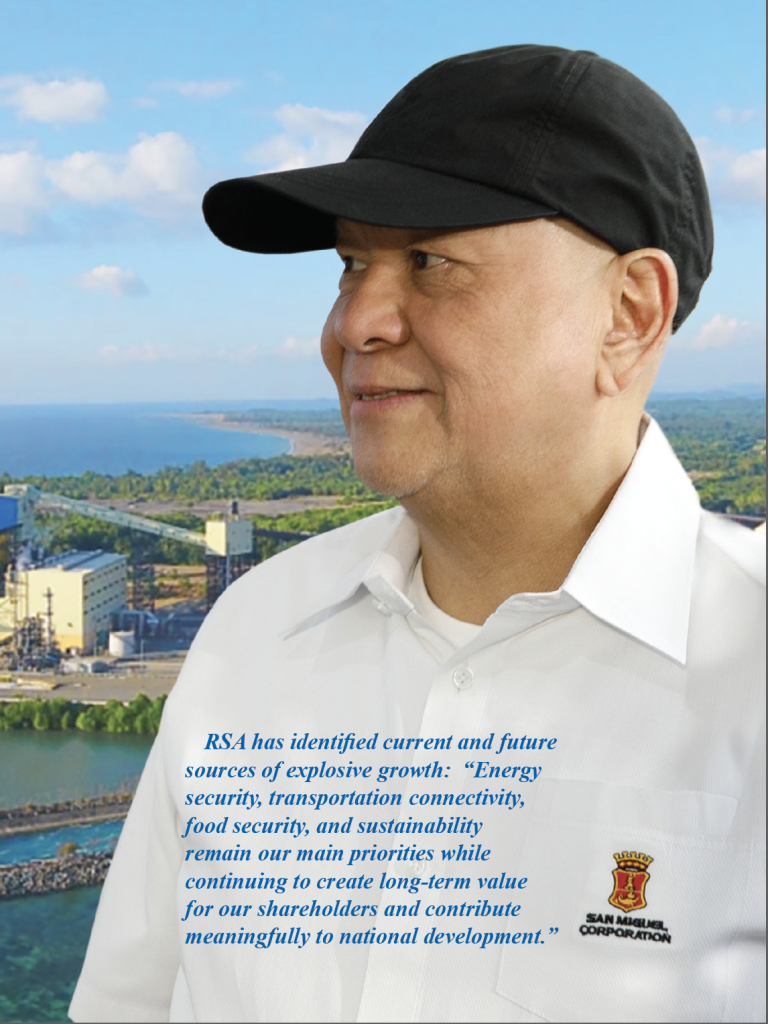
The best is yet to come. For San Miguel Corp., for its owners, for the customers it serves, and for Filipinos in general.
That is the strong message delivered by SMC Chair and CEO Ramon S. Ang when he addressed Tuesday, June 9, 2026 the company’s stockholders during their annual meeting conducted online.
RSA, 72, painted years of robust future SMC growth, thanks to heavy investments in key sectors of the economy, and “years of disciplined investments and execution”.
SMC has seven major businesses — food and beverage, packaging, energy, fuel and oil, infrastructure, cement, and real estate and other businesses. In six of these seven, SMC is No. 1, without peer.
For RSA, however, SMC’s main business is nation-building. Or making life better for most Filipinos.
The basic needs
Food is half of the consumer basket, especially for the poor. Energy accounts for 20% of household expenditure. We have among the highest priced electricity in the world. Transportation (if you can get it) is another 20% of household costs. Provide those and you feel great.
Even if you can get a bus, jeepney or train ride, the service is not guaranteed reliability. There are not enough roads and bridges. Without fail, the roads and bridges done by the Department of Public Works and Highways, are either accompanied by massive corruption or massive incompetence, or often, both. Thanks to corrupt DPWH engineers, corrupt private contractors, and even more corrupt senators and congressmen who are immune from shame and accountability.
Growth sources
RSA has identified current and future sources of explosive growth. “Energy security, transportation connectivity, food security, and sustainability remain our main priorities while continuing to create long-term value for our shareholders and contribute meaningfully to national development,” he told stockholders.
“We are expanding our power capacities and pushing ahead with investments in hydro and solar,” he revealed. At the same time, major SMC projects—the Bulacan Airport, MRT-7, and the South Luzon Expressway Toll Road 4 are in advanced stages of execution and or completion.
RSA the best and boldest CEO
SMC achieved its unmatched business leadership, thanks to the visioning of Ramon Ang, today the best and boldest CEO of the land. In 2007, RSA uncorked a massive diversification program that remade San Miguel–unrivalled in revenues (P1.7 trillion this year), portfolio of businesses, diversity of products and services, contribution to GDP (5.3%), and in making a profound impact on the country and on the daily life of Filipinos.
The Philippines’ largest and most diversified conglomerate (with P2.726 trillion assets) is focused on expanding its renewable energy portfolio and infrastructure projects while aggressively refinancing debt maturities to maintain financial stability amid ongoing market volatility, deteriorating peso rate, and geopolitical tensions.
The biggest power infra company
SMC achieved its peerless business dominance despite current seeming political instability with corrupt, murderous and dynastic senators converting their Senate into a playhouse of daily drama and a now notorious vice president, Sara Duterte, impeached twice, facing the trial of the century and disqualification for a presidential run in 2028.
SMC is the Philippines’ biggest power company. It is also the biggest infrastructure company. That is on top of being the biggest brewery, beverage and food company; the biggest cement company; the biggest packaging company, among its biggest-in-business bragging rights.
SMC has power generation capacity of 5,678 megawatts (MW). That’s 20% of the National Grid of 28,390 megawatts. By region, SMC supplies 25% of the Luzon Grid, 5% of the Visayas Grid, and 9% of Mindanao Grid.
In toll roads, SMC is also the leader. It has 1,162.52 kms of toll roads under management and or under construction, 76.36% of total toll roads operating or being constructed.
95% of the beer market
Of course, SMC is also the biggest in airports under management—the old NAIA, the new P750 billion Manila International Airport in Bulacan, and the Boracay airport in Caticlan.
Already, with NAIA and Caticlan airports, SMC currently services 60% of the local and foreign air passenger market.
In its traditional business, SMC has 95% of the beer market, powered by Red Horse Beer, 65.1% market share; San Miguel Pale Pilsen and Light, 24%; and Gold Eagle, 5.6%.
“Despite global and local operational headwinds, the iconic brands have remained resilient, supported by strong local demand and world-class production facilities, some of which are operating globally,” says San Miguel Food and Beverage Inc.. SMC beer and products are sold in 471,000 retail outlets.
Political risks
“Many of the major projects we invested in over the past few years are now operational and are generating significant value for our company,” RSA enthused.
“Across our businesses, these investments are improving efficiency, expanding capacity, strengthening market positions and creating new opportunities for growth.”
Bulacan airport runway by 2028
Bulacan’s New MIA first runway will be rolled out in 2028, enabling President Ferdinand R. Marcos Jr., whose six-year term ends on June 30, 2028, to claim he inaugurated Asia’s most modern airport, at least its first runway. “New MIA will be a game changer for national development,” exults Ang.
In February 2026, at the OECD workshop in Paris, San Miguel Aerocity, project proponent, led by Cecile L. Ang, director for corporate relations and special projects, presented the New MIA “as a case study on how major infrastructure projects can align with international environmental and social standards.” No flooding.
RSA’s vision for NAIA
At old NAIA, RSA has executed what looks like a miracle, 20 months after taking over its operation and management.
Checking in for flights and getting out of the airport upon arrival are now possible in just 15 minutes.
NAIA was once denounced as one of the world’s worst airports.
With a 15-year concession, RSA is repurposing NAIA into a a world-class hub. His overarching vision includes expanding total passenger capacity, introducing advanced biometric technology, and heavily improving infrastructure.
Plans include a new passenger terminal to increase capacity from 43 million to 62 million passengers yearly. NAIA was originally designed for 35 million passengers only.
In Asia, the Philippines had the worst aviation infrastructure—until San Miguel.
Cecile Ang’s case study and presentation focused on NMIA’s alignment with the IFC Performance Standards and Equator Principles, which are widely used by international lenders in evaluating large-scale infrastructure developments. SMAI made the presentation alongside Atradius DSB, the project’s export credit insurer, and Earth Active, one of its independent environmental and social consultants.
NMIA is compliant with global standards
SMAI said its presentation highlighted NMIA’s shift from local regulatory compliance to international lender-aligned environmental and social frameworks, including stronger internal management systems and the implementation of biodiversity and social risk measures for a challenging coastal site with critical habitat considerations.
The OECD participants viewed the project as a credible and transparent example of infrastructure development under challenging environmental and social conditions. They also noted the company’s openness in discussing early challenges, capacity-building efforts, and adaptive management approaches, particularly in biodiversity offsets and social performance.
NMIA has served as a practical reference for lenders in emerging market infrastructure, so that sponsors and lenders can work together to address gaps and strengthen environmental and social performance over time.
“The NMIA project is a clear example of how the cooperation of financial institutions and consultants can help project developers work towards compliance with International Standards. We carefully considered the project, and decided to support it. The results show that it was worth the effort,” Marije Hensen of Atradius Dutch State Business, the Dutch Export Credit Agency, said.
NMIA’s flooding and
land stability safeguards
Separately, SMAI said flooding, land stability, and environmental safeguards have been among the key considerations in NMIA’s technical and environmental review from the outset.
These continue to be addressed through assessment, mitigation planning, and oversight under both Philippine regulations and international lender standards.
NAIA modernization
A major milestone includes the successful opening of the new westbound off-ramp from the NAIA Expressway directly into Terminal 3, a significant project intended to relieve notorious local traffic congestion.
SMC remitted P57 billion to the government in its first year of operating NAIA.
SMC in seven major businesses
SMC, under Ang, is no longer merely a 136-year-old beer, food and packaging company. It now is the leader or a major player in a dizzying portfolio of seven major businesses—1) Food and Beverage, 2) Packaging, 3) Energy, 4) Fuel and Oil (Petron Corp.), 5) Infrastructure, 6) Cement, and 7) Real Estate, Banking and Others.
In 2025, Fuel and Oil (Petron) delivered the biggest revenues, P809.76 billion; followed by 2) Food and Beverage P419 billion; 3) Energy P157.2 billion; 4) Real Estate and Others, P65.87 billion; 5) Packaging P40.35 billion; 6) Infra P40.15 billion; and 7) Cement, P33.16 billion.
In terms of 2025 profits, the rankings are: 1) Energy P48.3 billion; 2) Food and Beverage P46.28 billion; 3) Fuel and Oil P15.62 billion; 4) Infra P14.75 billion; 5) Real Estate and Others P3.99 billion; 6) Cement P2.59 billion, and 7) Packaging P1.14 billion.
2026 revenues could hit P1.7 trillion
In 2025, SMC had consolidated revenues of P1.485 trillion, profits of P94.67 billion, and assets of P2.726 trillion.
SMC is on track to hit P1.7 trillion in revenues this 2026. First quarter sales rose 19% to P428.3 billion. Multiply that by four, you get P1.71 trillion. In a bad economy.
SMC revenues are equivalent to 5.3% of the country’s GDP. With its management of NAIA and the operation of the new MIA, along with the robust growth of its businesses, the conglomerate could deliver up to 10% of GDP share in five years.
SMC says its portfolio of companies is interwoven into the economic fabric of the Philippines, benefiting from, as well as contributing to, the development and economic progress of the nation.
Since adopting its business diversification program in 2007, SMC has channeled its resources into what it believes are attractive growth sectors, which are aligned with the development and growth of the Philippine economy.
SMC believes that continuing this strategy and pursuing growth plans within each business will achieve a more diverse mix of sales and operating income, and better position for SMC to access capital, present different growth opportunities, and mitigate the impact of downturns and business cycles.
Air transport outlook
The air transport sector acts as a massive economic catalyst, says AI. According to studies from the Philippine Institute for Development Studies (PIDS), every single-peso increase in demand for air transport generates a P2.72 increase in overall economic output due to direct and indirect effects. About 98% of tourist arrivals are by air.
The Philippines has about 90 national airports, too few for an archipelago of 7,600 islands; only eight airports are deemed international. Tourist arrivals hit 8 million (62% through Manila) in 2019 and fell after that. Passenger air traffic in Asia is projected to grow 4.2% yearly over the next 20 years from 1.7 billion passengers in 2008. Oxford Economics projects 88.3 million air passengers (including domestic) by 202, fifth largest in ASEAN.