
By TONY LOPEZ
Supporters of Ronald “Bato” Marapon dela Rosa, 64, frame his case as an issue of sovereignty, nationalism, an assault on the integrity of the Philippine justice system, and the most egregious excuse of all, an assault on the powers and independence of our Senate.
To that, cynics would sneer, “What a ton of bullshit”.
First, let’s dispense with the Senate. “This is the See-neet!” Bato exclaimed upon his return on May 11, 2026, after an absence of six months during which he and his eight relatives (his entire Senate office staff) continued drawing their gargantuan and undeserved salaries—our tax money.
This See-Neet has four sets of siblings—a third of the 24 members of the Senate are magkakapatid. Bwisit.
Another five senators are suspected plunderers in the multi-trillion-peso flood control scandal of the past seven years.
Two senators, siblings, are being investigated by the SEC for alleged stock market manipulation, the penalty for which is delisting, which means a tycoon’s claim of being a trillionaire is shattered.
Two senators, both from the South, are murder suspects—one is a murderer himself, the other financed the murders—with our tax money.
One senator has a son who has been slapped with a whopping P24-billion fine for failure to roll out a promised people’s solar network of 12,000 megawatts—enough to wipe out our energy crisis. Another is suspected to be an American citizen.
Of course, you know now how this See-Neet has sunk to an unprecedented low with the events of May 11-13, 2026. The scandal makes the Senate worse than garbage.
Garbage you can recycle, and you earn money. The Senate? You cannot recycle it. If you recycle it, you lose even more money. It is a rapacious See-Neet, populated as it is by murderers, swindlers, and plunderers. Caligula, the worst of 69 Roman emperors, would be thrilled to have such a Senate so he could send his horse, Incitatus, as the Senate president.
Now for the case of Bato dela Rosa. He is wanted by the International Criminal Court in The Hague, Netherlands. For the crimes against humanity of murder and attempted murder.
Per ICC records, Bato is a co-perpetrator in Rodrigo Duterte’s “War on Drugs” from Nov. 1, 2011, to March 16, 2019.
“While the Philippines’ withdrawal from the Rome Statute took effect on March 17, 2019, the Court retains jurisdiction with respect to alleged crimes that occurred on the territory of the Philippines while it was a State Party, from Nov. 1, 2011, up to and including March 16, 2019. By ratifying the Statute, the Philippines explicitly accepted the jurisdiction of the Court, within the limits mandated by the treaty. These provisions and the ensuing obligations remain applicable, notwithstanding the Philippines’ withdrawal from the Statute,” says ICC.
Bato authored the “common plan” to neutralize (kill) alleged criminals between Nov. 1, 2011, and March 16, 2019. Bato himself was linked to 35 alleged murders committed between July 3, 2016, and the end of April 2018.
Assessing the murder cases, “the Chamber finds that there are reasonable grounds to believe Mr. Dela Rosa has committed the crime against humanity of murder.”
On Sept. 15, 2021, the ICC began investigating the “War on Drugs” murders of Nov. 1, 2011, to March 16, 2019. The ICC probe was suspended but was resumed on Jan. 26, 2023. On Nov. 3, 2025, the prosecution sought from the ICC an arrest warrant against Bato. On Nov. 6, 2025, the arrest warrant was issued. Forthwith, Bato went into hiding but continued drawing his P400,000 a month salary.
Per ICC records, “the material provided by the Prosecution shows that the Davao Death Squad (the ‘DDS’) members and later the Philippines’ law enforcement personnel targeted a large number of persons who were on the territory of the Philippines and allegedly involved in criminal activities, in particular drug-related ones. The Prosecution refers to 35 incidents as a sample of the alleged conduct. Even though the Chamber only assessed 14 of the incidents, this representative number already shows that there was a course of conduct involving the commission of multiple acts against a civilian population on the territory of the Philippines. These violent acts were committed by different cities or governmental authorities and organs, pursuant to a policy aiming at putting an end to the criminality in the Philippines by all means, including by killing alleged criminals.”
Says the ICC: “The Chamber finds reasonable grounds to believe that an ‘attack’, within the meaning of Article 7(1) of the Statute, was directed at a civilian population; initially pursuant to an organizational policy and later, when Rodrigo Roa Duterte (‘Mr. Duterte’) became the President of the Philippines, a State policy.”
ICC: “Moreover, there are reasonable grounds to believe that this attack was both widespread and systematic. In this regard, the Chamber notes that the attack took place over a period of several years, and thousands of people are reported to have been killed, a sample of which is analyzed… In addition, the material provided by the Prosecution shows that the killings shared common features, such as a similar modus operandi, namely in terms of the locations and the methods of killing; the profiles of perpetrators; and the profiles of victims.
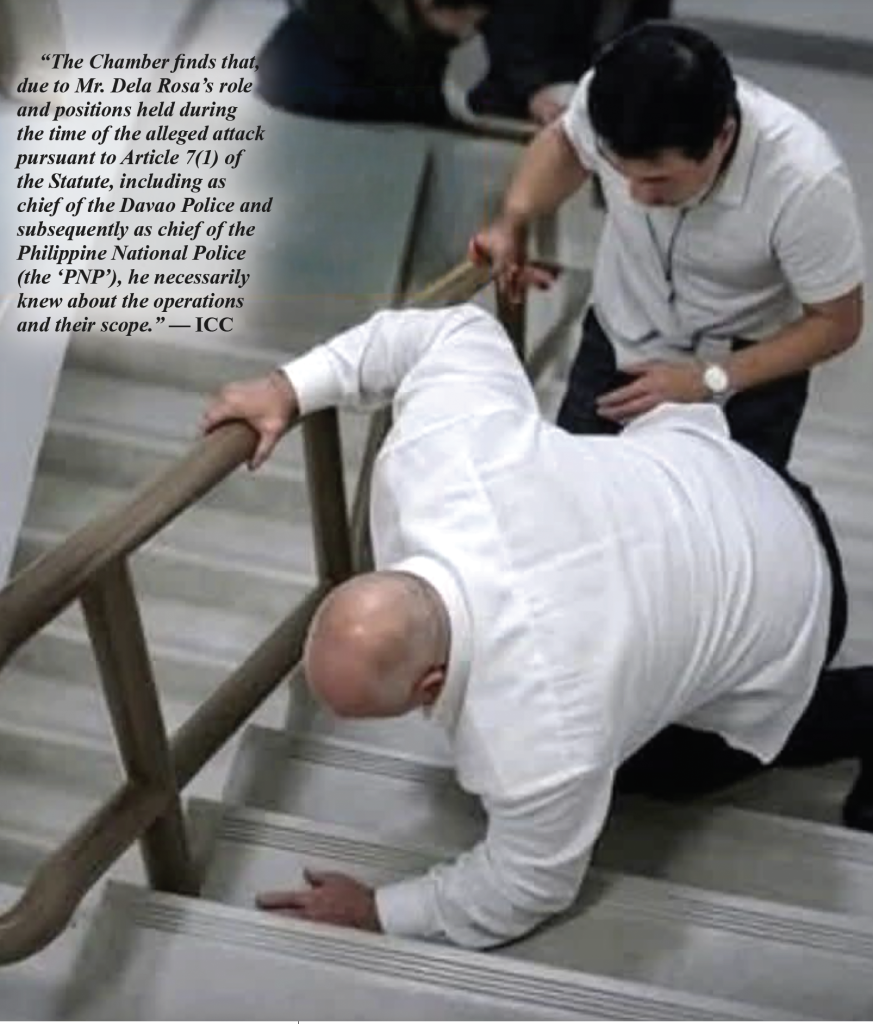
“The Chamber finds that, due to Mr. Dela Rosa’s role and positions held during the time of the alleged attack pursuant to Article 7(1) of the Statute, including as chief of the Davao Police and subsequently as chief of the Philippine National Police (the ‘PNP’), he necessarily knew about the operations and their scope. Indeed, the material before the Chamber shows that his contributions to the common plan furthered the widespread and systematic attack directed against all persons designated as involved in criminal activities, especially drug-related ones, and, based on his own public statements, that he intended his actions to be part of the alleged attack against the civilian population.”
Summing up, Bato dela Rosa is—a lawmaker, lawbreaker, murderer, a fugitive from justice. An honorable senator.