
By ELIZABETH H. LEE
(Speech during the FPI Business Summit 2026 at Shangri-La The Fort, Oct. 29, 2026)
Senate President Sherwin Gatchalian; SEC Chairperson Francis Lim; Agriculture Secretary Francisco Tiu Laurel Jr.; Presidential Legislative Liaison Officer Secretary Joey Salceda; DOE Undersecretary Mario Marasigan, representing Energy Secretary Garin; BIR Head Revenue Executive Assistant -Atty. Victoria Go-, representing Commissioner Mendoza; my fellow officers and members of the Federation of Philippine Industries; fellow industry leaders; friends in the media; ladies and gentlemen:
Good morning.
If we can buy everything but build very little, how secure is our future?
That question should trouble us. Because every product we make creates something bigger: Skills, suppliers, jobs, incomes, and opportunity. And when a nation loses the capacity to produce, it cannot import its way back to strength.
Next gen strategy
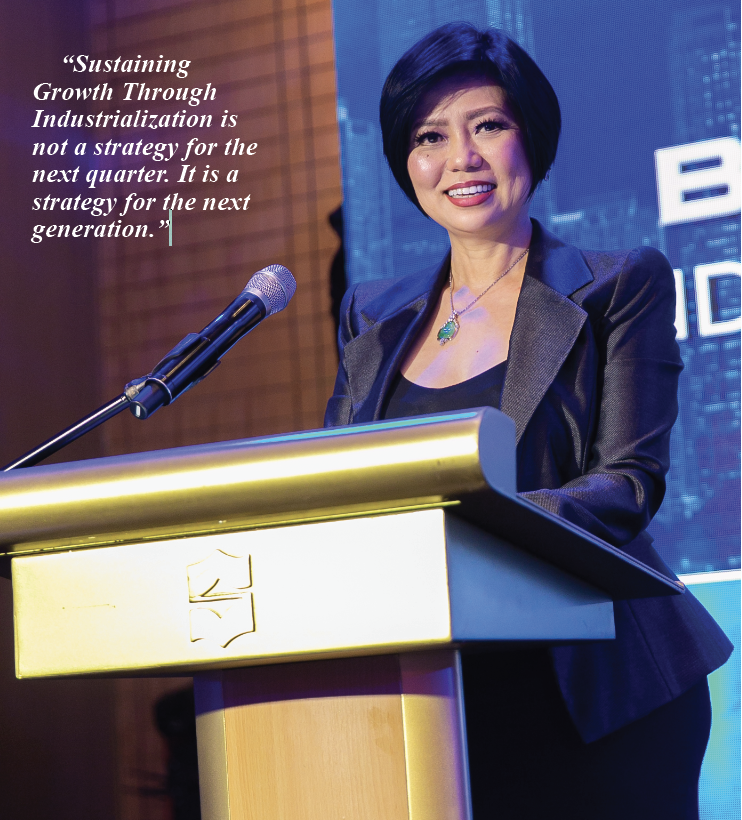
That is why Sustaining Growth Through Industrialization is not a strategy for the next quarter. It is a strategy for the next generation.
This year, Philippine industry has been hit by four shocks at once: Energy, food, the peso, and trust.
Energy costs are hostage to a war beyond our shores. Food inflation is straining Filipino families. A weaker peso is raising the cost of every imported input. And slowing investment reminds us that confidence matters.
Three of these shocks came from outside.
The fourth, we made ourselves.
And before anyone writes off the Philippine economy, let me say this clearly: We have been here before.
And we know how to come back.
The pandemic brought our economy to its knees. Two years later, we were growing 7.6% — our fastest pace in nearly half a century.
And this year, after nearly four decades of trying, the World Bank recognized the Philippines as an upper-middle-income economy.
Nobody handed us that. Filipino workers, farmers, entrepreneurs, overseas Filipinos, and manufacturers earned it.
So when people ask whether we can overcome challenges– history has already answered: Yes. The real question is how fast we recover — and how much stronger we emerge.
Resilience
Our people’s resilience is one of our greatest strengths. But resilience must never become an excuse for accepting what can be fixed.
Every crisis leaves a nation either weaker or wiser. Let this one leave us wiser.
We cannot end a war. We cannot stop El Niño. We cannot set global oil prices.
But we can fix our ports. We can strengthen local supply chains.
We can simplify tax compliance. We can reform our power sector, so that power becomes a reason to invest in the Philippines, not a reason to leave it.
And we can give investors the policy stability they need to build for the long term.
Do that, and every business that wants to build here will have the confidence to do it.
And many already want to. So here’s the paradox we must solve.
Start with the good news — and it is real.
In August, our factories had their best month in nearly a decade. Exports hit a 35-year high of $9.11 billion, and more than 80% came from manufactured goods. When our factories perform, the world buys.
Investors see it too. And look where they are placing their bets.
Foreign investors are betting on factories.
Compared with last year, their pledges jumped 52 % in the first quarter, to nearly P43 billion, and 68% in the second, to P115 billion — and more than two of every three of those pesos went to manufacturing.
Filipino investors are betting on power.
The BOI approved P462 billion in the first half — most from Filipino firms. Nearly three of every four pesos went to energy. That’s good. But — less than two of every hundred pesos went to manufacturing.
We need the power. But power without factories is only half an industrial strategy.
Now the hard truth: Pledges are not factories. From January to July, net FDIs fell by nearly a quarter. This is not yet a verdict — but a warning.
Part of it is the world: The war, oil, a weaker peso. But Vietnam faced the same storm — and in the same months, its foreign investment rose nearly 12%. Analysts, investors, and foreign chambers point to a factor that is entirely within our control: TRUST.
And trust cuts both ways.
In 2013, we improved governance and earned our first investment-grade rating.
Investors responded. Capital followed. Four years later, foreign investment had tripled to a record $10 billion.
Trust created investment then. It can create investment again.
So here is the paradox: Our factories can deliver, foreign capital wants more of them, Filipino capital is building our power — but pledges are still promises.
Our task is to become competitive and trustworthy enough to turn them into factories and jobs, here at home.
That must guide our priorities.
Industrialization is growth plus preparedness. The era of cheap, open, and predictable supply chains is over.
A nation that cannot produce enough and power enough is a nation at risk.
Food tells the same story. When drought strikes the farm, it hits the family table, the food processor, and the worker’s wage all at once.
What we need is economic insurance.
That is why this Summit matters, and why our message is urgent. And that is why the leaders who have joined us today matter so much.
The agenda is clear:
Affordable power, competitive taxes, efficient ports,
Stronger supply chains, smarter regulation, higher-value agriculture, and more manufacturing investment.
No single institution can deliver it. It takes all hands on deck — and our speakers are already moving.
Senate President Gatchalian: says the P7.2 trillion budget must deliver growth, lower inflation, and resilience to El Niño.
With SEC Chair Francis Lim at the helm, fast lanes are opening capital markets to key sectors; manufacturers should be next.
Secretary Tiu Laurel is protecting farmers from El Niño and building stronger farm-to-market links.
With Sec. Joey Salceda steering the legislative agenda, Tatak Pinoy and CREATE MORE can unlock investments where they matter most.
The DOE is working to keep the lights on and power bills affordable.
The BIR is cutting red tape with simpler rules, digital processes thru Ease of Paying Taxes Act (authored by SP Win)
In closing, let me return to where I began.
If we can buy everything but build very little, our future belongs to whoever sells to us.
But that is not the Philippines we want. And it is not the Philippines we are capable of becoming.
We did it before. We can do it again. Only bigger.
Let us build an industrial Philippines.
Because industry is not just a sector. It is the engine of growth, the backbone of resilience, and how nations rise.
And this is our moment.
To turn “Made in the Philippines” from a label into a national ambition.
Buy Local. Build Philippines.
Let “Made in the Philippines” mean more than where a product came from. Let it stand for how far we can go.
Thank you and to God be the glory.