
When he was five, Junji Torres started painting. He fell in love with art.
I met Junji in high school when we were both chosen to compete for a Jose Rizal art competition. I don’t know what I was doing there—but I welcomed being taken out of my boring class to pretend draw in the library. I had never talked to Junji before. He was quiet like me, and we were not in the same class. But after seeing him draw, I instantly recognized his talent.
Junji’s skill reminded me of my exceptionally talented Dad, which gained him my respect. So I bothered to talk to him. As we conversed, it was refreshing to find that Junji was insightful and funny. He had the confident calm of an old man. My middle-aged mind found a kindred connection.
Junji went on to obtain a Fine Arts degree from the University of Santo Tomas and pursued a creative career. But the pressures of clients, deadlines, and a toxic work environment depleted him so much that he stopped painting for over a decade.
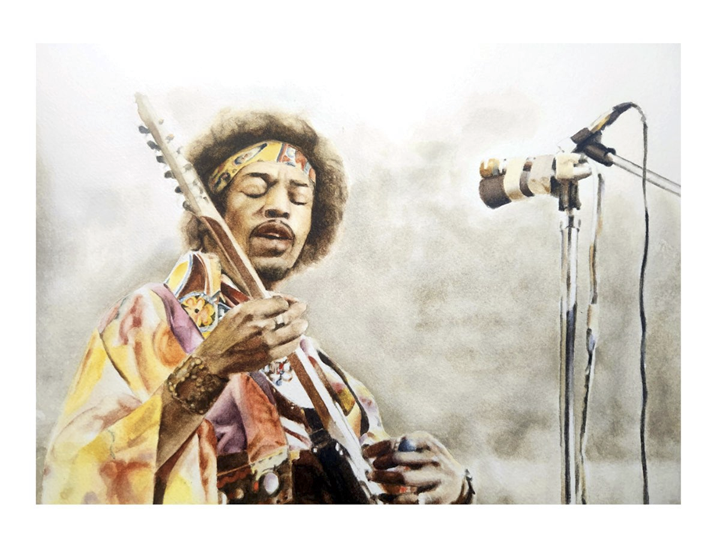
Jimmy Hendrix by Niordj in watercolor
What made Junji come back to art?
“I resumed painting when I found my unfinished artwork in a sketch pad that I hadn’t opened since 2017. When I tried working on one of the old paintings, I found that the paper did not behave properly. Watercolor paper often goes bad after nine years because the gelatin or synthetic sizing agent—which controls water absorbency—breaks down, especially in humid weather,” says Junji who signs his works as Niordj.
“I had to order new paper, but I still continued working on the old painting even though it was very challenging.”
Last July, Junji was invited to participate in a national watercolor competition, Kulay sa Tubig. His work, Rock & Roll Forever, was among those chosen out of a thousand.
About the painting
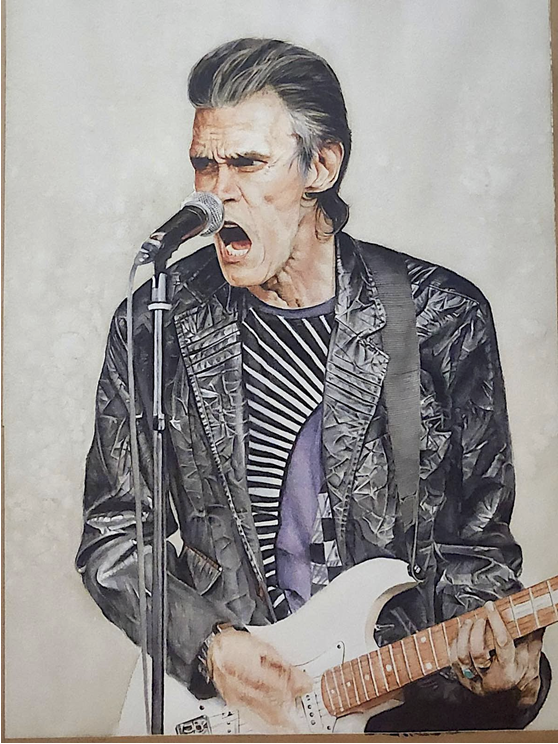
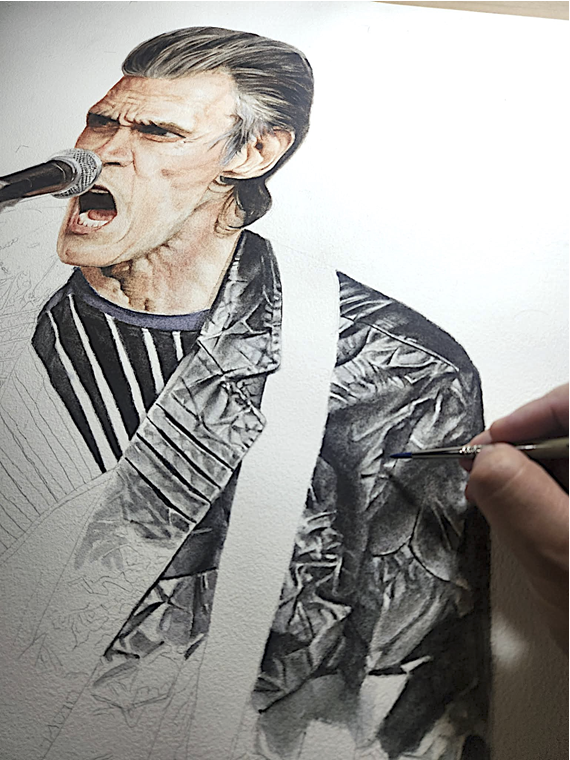
“Rock & Roll Forever is a watercolor tribute to Pepe Smith, frontman of the Juan dela Cruz Band and one of the pioneers of Pinoy Rock.”
Joey “Pepe” Smith is a Filipino-American singer, songwriter, drummer, and guitarist who was called the “Mick Jagger of the Philippines.
“The painting captures the energy, passion, and enduring spirit of Pepe Smith as a performer—an artist who continued to give himself completely to music, strumming his guitar and singing with the same fire even as the years passed.”
“More than a portrait, the work is a reflection on time, passion, and legacy. Pepe Smith may no longer be with us, but his music continues to resonate across generations. His voice, his performances, and the spirit of Pinoy Rock he helped shape remain alive.”
“Through Rock & Roll Forever, Niordj seeks to celebrate that enduring spirit: the artist may be gone, but the music, passion, and legacy live on forever.”
What inspired you?
“I saw Pepe Smith perform at The Peninsula Manila in 2012, and I was completely blown away. There was something unforgettable about the way he performed—the passion, the intensity, the raw energy. He didn’t simply sing and play; he seemed to pour his entire self into the music. That image stayed with me long after the performance ended.”
“Years later, I found myself wanting to capture that feeling on canvas.”
“I chose Pepe Smith as my subject because I wanted to translate that same intensity, passion, and energy into a painting. His expression, the power behind his singing, and the movement of his hand as he strummed the guitar became essential elements in bringing the portrait to life. I wanted the painting to feel as though you could almost hear the music and feel the energy of his performance.”
“One of the biggest challenges was painting his leather jacket. Capturing the folds, creases, texture, and guitar strap while keeping Pepe instantly recognizable was quite demanding. Every detail had to work together. He had to look unmistakably like Pepe Smith, but at the same time, the portrait had to retain the spirit and movement of the performer I remembered.”
“I deliberately kept the background very light and understated so that nothing would compete with Pepe. I wanted the viewer’s attention to stay on his expression, his jacket, and the energy of the moment. That is how I remember him from that night at The Peninsula—larger than life, completely immersed in his music.”
“For me, this painting is more than a portrait. It is my tribute to Pepe Smith, to his contribution to Filipino music, and to the enduring spirit of Pinoy Rock.”
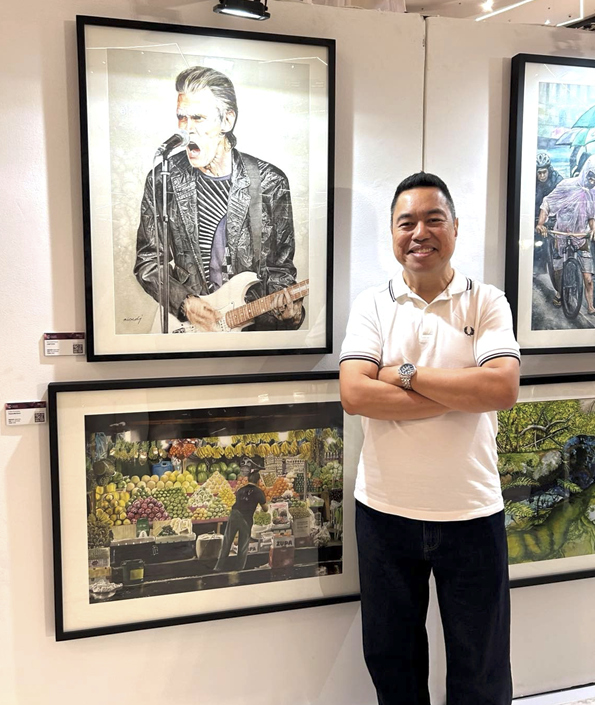
What were your challenges with this painting?
“I received my invitation to participate in Kulay sa Tubig on July 24. I began the painting on July 28 and completed it on August 15, putting in approximately 90 hours of work.”
“Working under such a tight deadline was a challenge. There were moments when I honestly wondered if I would be able to finish the painting on time. There were long hours, difficult passages, and plenty of moments when I had to push through uncertainty and keep going.”
“I’m deeply grateful that I was able to complete the painting within the deadline. More than anything, I believe God guided me through every challenge and gave me the strength, patience, and inspiration to see the work through.”
Junji’s advice to artists
“Draw or paint every day. Never stop thinking about art. Sure, your paintings may not be great right now, but as you continue on your journey, your work will definitely improve over time.”
“The biggest struggles as an artist are mental and creative blocks. Some days, you have to force yourself to be creative on a strict schedule just to meet your deadlines, which can somehow kill the joy of making art. I am also a perfectionist, and I have abandoned some projects simply because they didn’t match the vision I had in my head.”
Tip 1: Dedicate one sketchbook entirely to bad sketches or messy paintings. This gives you total permission to make terrible art. Once that pressure vanishes, your true creativity begins.
Tip 2: Do not judge your painting immediately. Judging while painting completely kills your momentum. If you create a piece today, put it away in a drawer and look at it after a few days with fresh eyes.
How Junji overcomes:
a. procrastination – This is common among artists. I actually embrace it because when you are not actively painting, that is often when the best ideas come to you.
b. loss of confidence – Whenever I start to feel that I am not good enough, I focus on finding practical ways to improve.
c. lack of inspiration or feeling blocked – I visit a museum or look through photos I’ve taken at various galleries in the past. I also watch YouTube videos about art or listen to music. I have found that listening to music frequently generates new ideas.
d. lack of funds – I simply limit myself to whatever materials I have left. Even if it is just a small pencil, I will find a way to create art with it.
e. feeling that no one cares about your work – At the end of the day, there will always be someone who connects with your work. Art is entirely subjective.
f. jealousy – Jealousy only exists if you choose to compete with other artists. I would much rather collaborate with my peers and create beautiful art together.
Where Junji paints – I paint in a small nook in our house that has large windows for plenty of natural light.
It’s never too late for Art
Junji’s Stop and Go artistic trajectory is similar to famous artist Paul Cézanne who studied art early but only had his first exhibition at age 56. He continued to define his style well into his 60s, to eventually become the Father of Modern Art.
Another late bloomer is Claude Monet, who only developed his signature impressionist style after age 40. He spent the next 40 years of his life studying and painting his iconic Water Lilies series into abstraction.
Henri Rousseau worked as a customs officer until he retired at age 49, when he decided to become a self-taught painter.
Like agoodcasserole,ittakes a loooong time to produce memorable art; art that stays with you because it moves you. Each time you create, you become better. As you age, you learn more, know more, experience more—all of which influence your art.
After decades, you have the confidence and competence to express your unique style; that anyone can tell it’s yours, and no one else can copy.
Junji is on his way. “Now that I’ve returned to painting, I plan to dedicate more time to watercolor and continue experimenting and pushing the boundaries of the medium. I also hope to explore acrylic painting very soon.”