
By TONY LOPEZ

One trillion pesos.
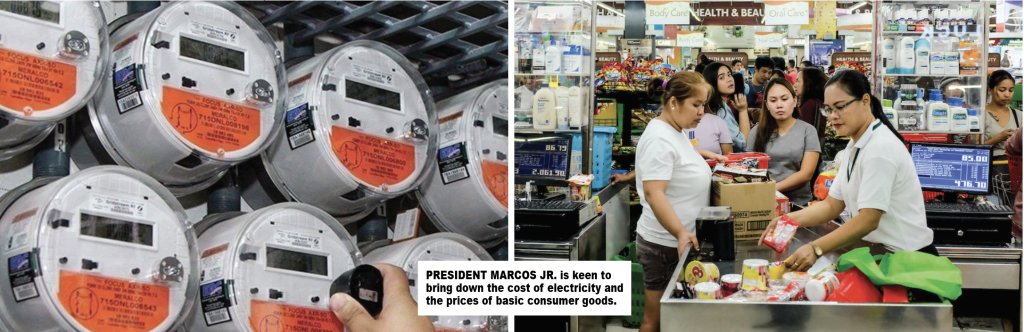
That is my estimate of the money households and businesses who consume electricity will save as windfall if President Ferdinand R. Marcos Jr. (PBBM) makes good on his promise to put a stop to the onerous system loss charges of power generation companies and electricity distributors and/or retailers.
“It’s about time we did away with the system loss being passed on to consumers,” the President said in his July 27 State of the Nation Address (SONA) to thunderous applause. “It is not the fault of consumers why there is such a thing as system loss.” (Cheers and applause). “It is not right that consumers should bear this burden.”
No to VAT
The President also disliked the 12% value added tax slapped on system loss charges. The VAT totals P80 billion a year.
The system loss rate of Meralco the country’s largest electricity retailer is 5.6%. Electric cooperatives enjoy 12%. If VAT on system loss is P80 billion (an estimate given me by Secretary Joey Salceda of the Presidential Legislative Liaison Office, PLLO), and VAT is 12%, this implies total system loss charges of P1 trillion—3.3% of nominal GDP of P30 billion.
Tax breaks
Additionally, in his SONA, PBBM promised three tax breaks. One, to expand the tax exemption privilege to include those earning not more than P350,000 yearly, and to lower the tax rate of those already paying income taxes. Two, small businesses shall no longer pay any minimum corporate income tax (applause). The minimum corporate income tax is two percent of gross, starting from the fourth year.
Tax amnesty
Finally, an amnesty shall be declared for those who have failed to pay their income tax, donor’s tax, and value added tax, plus the waiver of penalties (25%) on these unpaid taxes. The Tax Amnesty Act (RA 11213), for delinquencies in 2017 and prior years, expired in 2020. Hence, the need for a new tax amnesty law.
I estimate the tax exemptions, reductions, and waivers to cost the government P200 billion, depending on the language and implementing rules of the laws still to be designed by Congress.
P1 trillion from foregone system loss charges, plus P80 billion from no VAT on system losses, and P200 billion to be waived by the government from various other taxes—that’s a total of P1.280 trillion cash windfall going to electricity consumers (30 million households), wage earners, and small businesses.
The P1.28 billion is the largest ever economic stimulus promised by the government since the 2020 COVID-19 pandemic.
In banking, a P1.28 trillion deposit has a gearing ratio of seven times, or P8.96 trillion. That is the money that could be pumped into the economy to rescue it from its current doldrums.
In 2021, the Bangko Sentral pumped P2 trillion into the economy and immediately reversed growth from a whopping 9.5% COVID-induced negative growth in 2020 to a respectable 5.7% GDP gain in 2021 and a robust 7.6% growth in 2022. It is the most spectacular economic course correction ever achieved in this country.
If properly executed, a P1.28 trillion economic stimulus could add two percentage points to bring GDP growth back to 7% clip per year by 2027, coincidentally an election spending year to decide the 2028 successor to Marcos Jr.
Will Congress play ball with the President’s game plan?
Congress has no choice. In the Senate, eight of the 12 senators whose terms end in 2028 are due for reelection. Six of the eight are identified with the Duterte bloc. They face all kinds of charges, real and imagined.
In Congress, 257 (81% of 318 congressmen) signed the articles of impeachment indicting Vice President Sara Duterte. They should benefit from a massive economic stimulus plan that has no precedence, either as reelectionists or as candidates for other elective posts.
What is system loss
System loss is a fancy term to describe electricity lost as power is delivered from its source to the end user. Usually, system loss means theft. Or faulty wiring. Like having an unauthorized line or jumper to one’s house to steal electricity that otherwise one must pay for.
Simply stated, system loss can be anything and everything to cover unexplained loss of electricity. For all we know, system loss is merely an accounting entry or engineering magic to cover up for the utility’s incompetence, inefficiency, or even corruption.
But the Electric Power Industry Reform Act (EPIRA) of 2001 allows it, legalizes it, institutionalizes it.

Outrageous concept
The concept is outrageous. Imagine you are a bank. You were robbed the night before, of say P10 million. You cannot explain the robbery. So the morning after, you call each of your depositors to tell them, “Sorry, Dear Depositor, we were robbed last night. We don’t know what happened, how, and why. Can we charge you a fee to cover the P10 million we lost, divided equally among you depositors, pro rated according to the amount of your deposits?”
Is that fair? No, of course.
Banks do not have a concept of system loss that is shouldered by consumers.
But utilities—electricity and water—do.
To his credit, BBM has seen the unfairness and apparent illegality of system loss.
A caring President
The Marcos Jr. who addressed Congress and the nation last Monday is a caring, pro-people president. He seems to have decided that rather than spend the money saved by the government from its anti-corruption campaign, he will let the Filipino people spend it—to buy their basic needs, pay tuition, invest in businesses, travel, or stash as savings for future use.
The P1.28 trillion, after all, is the largest direct cash transfer ever promised by any sitting president. “I hear you,” said Marcos Jr. after the near debacle in his 2025 senatorial ticket in the last elections. He then identified the issues his government must face head-on—inflation, jobs, corruption, and the everybody burdens people carry. “Let us move forward together,” the President urged